

How we calculate fair rewards for Destination Experts
Discover how inHotel uses AI and the Purchasing and Wage Index (PWI) to ensure fair, impactful rewards for Destination Experts, empowering local communities.


Strengthening your local community through AI
At inHotel, we believe that the heart of the tourism industry is the local community. Whether you are welcoming a guest at the front desk, serving a coffee in a nearby cafe, or sharing the history of your city on a guided tour, you are the reason travelers feel at home.
We provide you with AI agents to augment your abilities and build community resilience. By deploying these agents, you create an interconnected ecosystem that links travelers to local offerings and enables people in tourist destinations to support one another.
Unlike global travel platforms that extract high commissions from your destination, inHotel and our partners in the Direct Booking Alliance reward you for building this distributed network and keeping the economic value within your community.

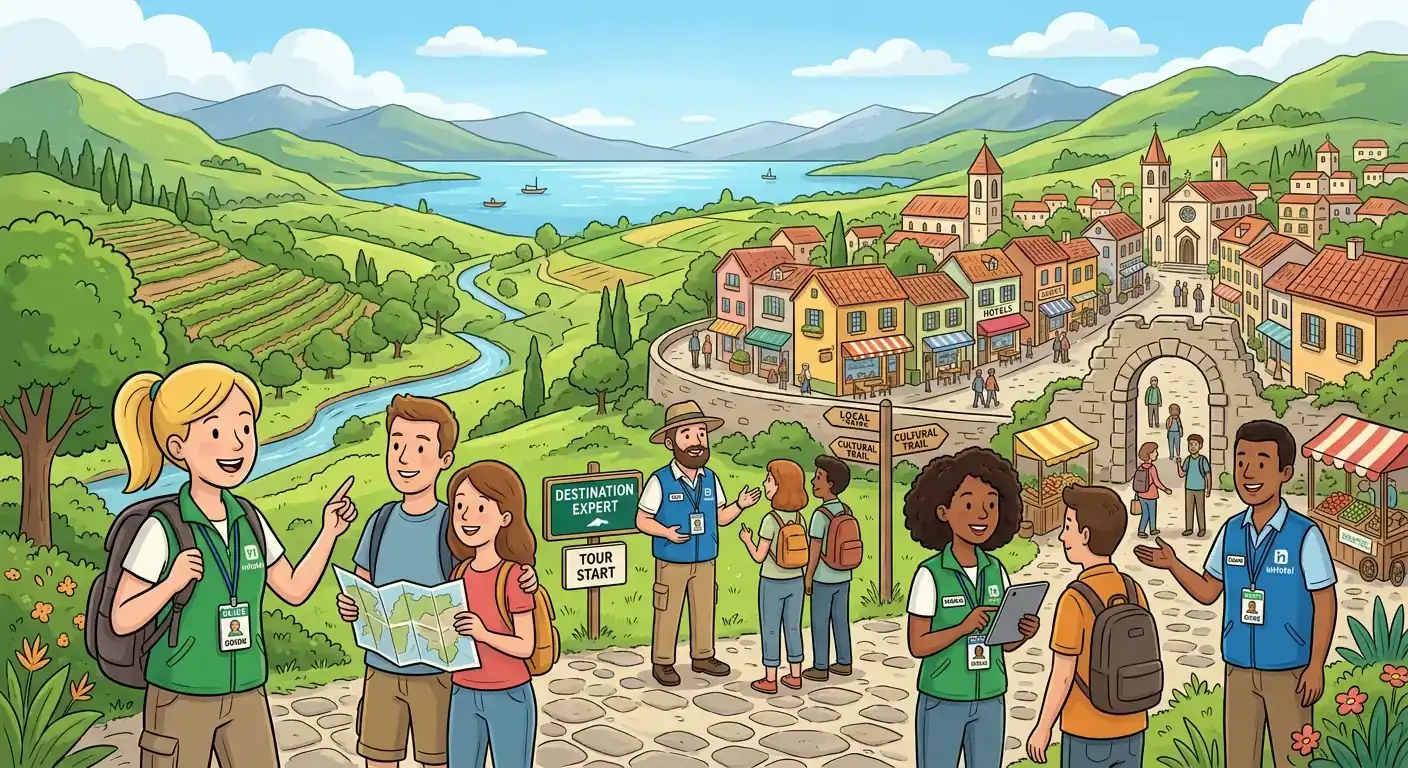
AI agents connect local experts to strengthen the destination economy.
To make this impact meaningful, we ensure every reward carries real weight where you live. This is why we use the Purchasing and Wage Index (PWI).
What is the Purchasing and Wage Index (PWI)?
The Purchasing and Wage Index (PWI) is an economic adjustment system developed by inHotel to calculate geographically fair rewards for tourism professionals in destinations (Destination Experts).
A fixed amount of money, like €100, does not have the same value everywhere. In some cities, that amount might cover a week of groceries, while in others, it might only cover a single dinner.
Our goal is equity. We want every partner in our ecosystem to feel equally motivated and respected. By adjusting rewards based on your local economy:
- Your rewards have real purchasing power in your country.
- We support the local economies of the destinations travelers love.
- Local experts like you can continue to thrive and grow within your own neighborhoods.
How the PWI is calculated
The PWI is based on internationally recognized economic data from the World Bank and measures both local Purchasing Power Parity (PPP) and average income levels.
To calculate the score, we combine:
- local cost of living and purchasing power (
PPI =PPP/Market Exchange Rate) - local wage and income standards (
GNI per capitaused as a proxy for theAverage Hourly Wage)
Our methodology gives greater (70%) weight to real purchasing power, while also recognizing professional wage differences between countries (30%). Final scores are normalized and rounded to ensure global fairness and stability.
How PWI works in practice
The PWI looks at the cost of goods in your country and the local value of professional time. We then adjust the incentive so that the "feeling" of the reward is consistent across the globe.
For example, to achieve the same motivational impact as a €100 incentive in the United States, a Destination Expert in India would receive €20, while a Destination Expert in Spain €55 and in Australia €85.
This ensures that the person in India receives a reward that carries the same prestige and local weight as the person in Australia.
Equity is about ensuring that every contribution has the same impact on a person’s life, no matter where they call home.
Current PWI rates by country
We value your feedback
Economies change and local realities can shift. If you look at the PWI for your country and feel it does not accurately reflect your local cost of living or professional wage standards, please let us know.
We are committed to growing together and ensuring that the inHotel ecosystem remains the most fair and supportive network for tourism professionals worldwide.
Frequently Asked Questions
How are rewards calculated for Destination Experts in tourism and hospitality?
The calculation combines two economic measurements pulled from internationally recognized data sources. First, the system looks at purchasing power parity, which measures how far money stretches in a specific country. Then it factors in income levels using gross national income per capita as a stand-in for average wages. Purchasing power receives a stronger weighting because everyday costs shape financial reality more directly than salary figures alone. This method creates more balanced rewards for people working in hotels, tours, restaurants, and other tourism roles across different regions.
Why is my reward lower than a hotel receptionist in another country for the same work?
Tour guides and hotel staff often compare payout numbers directly, especially inside international hospitality networks. The problem is that €100 does not carry the same day-to-day value everywhere. The reward model adjusts payouts using local purchasing power and wage standards so the incentive feels equally meaningful in each destination. A concierge in Switzerland faces very different living costs from a guide in Vietnam. The goal is not matching numbers on paper. It is making sure both professionals feel properly rewarded in the context of their own local economy.
How can I maximize my rewards as a Destination Expert in hospitality?
The strongest earners are usually the people who actively strengthen the local tourism network instead of treating the system like a passive referral tool. A receptionist recommending nearby family-owned restaurants, or a guide steering guests toward local experiences, creates measurable value inside the destination economy. Rewards are tied to participation in that ecosystem. Since payouts are already adjusted for local purchasing power, comparing your country’s rate against another market is less useful than increasing engagement and community connections where you operate.
Can Destination Experts challenge or review their country’s reward rate?
Yes. inHotel explicitly invites feedback when Destination Experts believe local conditions are no longer reflected accurately in the published rates. Economic conditions shift constantly, especially in tourism-heavy cities where housing, transport, and food prices can climb quickly during growth periods. A front desk employee in Lisbon or Reykjavik may experience cost increases much sooner than official national averages reveal. Feedback from people working directly inside the destination helps keep the reward model tied to real local conditions instead of outdated assumptions.
How do rewards for Destination Experts support local tourism businesses instead of large booking platforms?
Our model is built around keeping economic value inside the destination rather than extracting commissions away from it. When hospitality professionals guide travelers toward local restaurants, shops, experiences, and services, they strengthen businesses inside their own communities. The article positions this as an alternative to global travel platforms that remove revenue from local economies. By rewarding people who help grow direct local connections, inHotel encourages a more resilient tourism ecosystem where independent businesses and destination workers benefit together instead of competing for scraps.