


Build Agent Skills with Advanced Prompts
Travel and hospitality experts can turn high-value LLM prompts into dynamic, reusable, protected Agent Skills that can be discovered, used, and monetized.


What is an Advanced Prompt Agent Skill?
An Advanced Prompt Agent Skill is a structured, dynamic prompt packaged as a reusable Skill that an AI assistant can execute reliably in real travel and hospitality environments. Unlike simple prompts, it adapts to each customer’s organization, role, and context through variables, while executing the same expert logic every time.
Because it runs inside inHotel’s hospitality-native environment, it delivers a number of platform-level advantages compared to general AI tools. The agent executing the prompt leverages industry best practices, aligns with the hotel’s business goals, and respects strict data privacy standards. Instead of isolated prompts in individual user accounts, the Skill becomes part of a workforce-aligned AI system that understands the business objectives and policies. Data remains private and is never used to train public models. Pricing is structured around assistants and roles rather than per-seat licenses, making it cost-efficient for full-team adoption.
The underlying prompt logic is protected. Customers and users interact only with the output, not the prompt itself. This allows hospitality experts to turn high-value prompts into durable, distributable assets without exposing their intellectual property.
Advanced Prompt Skills are best suited for one-step decisions, analysis, or guidance, where a single agent response is sufficient and no multi-step orchestration across agents is required.
When does this approach make sense?
Building an Advanced Prompt Skill is a strong fit if:
- You already have a prompt that delivers reliable, high-quality results
- The task can be completed in a single agent response
- You want consistent execution without copy-pasting prompts
- You want others in the industry to benefit from your expertise
- You want to protect and potentially monetize your prompt logic
This is typically the lowest-risk and fastest way to start building Agent Skills.
How Advanced Prompt Skills are discovered
Once published, an Advanced Prompt Skill is listed in the inHotel Skills Catalog. This serves two purposes:
- Thought leadership and recognition
The publisher is credited as the author, positioning them as a subject matter expert in their domain. - Industry-wide distribution
Travel and hospitality professionals across the industry can discover the Skill and acquire it for their AI agents to enhance their capabilities.
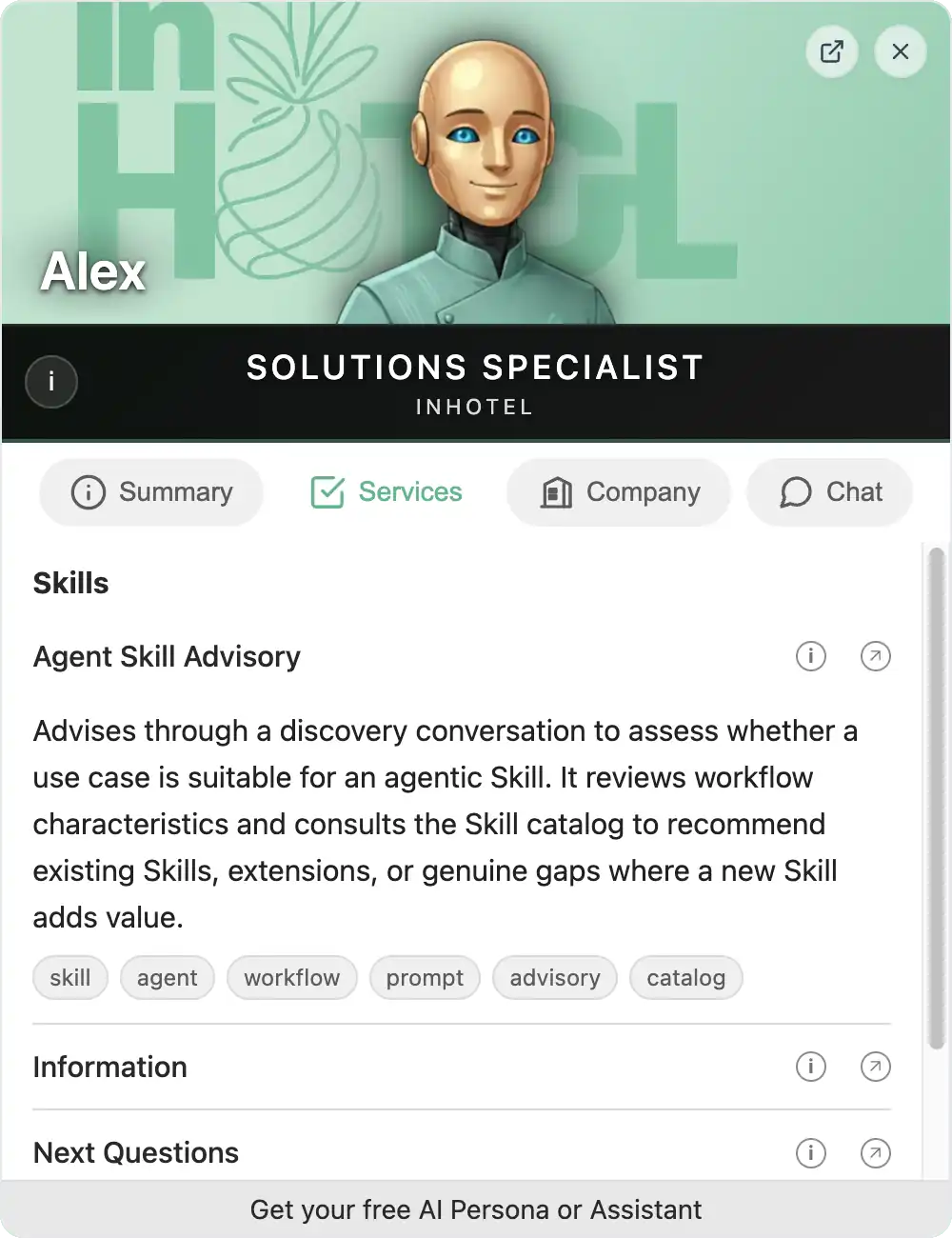
Once an AI agent possesses a Skill, it advertises that capability in its agent card, which functions like a business card for agents. Agent cards make Skills visible to both people and other agents, clearly signaling what the agent can do and when it should be engaged. This allows expertise to spread organically through daily operations without requiring training or explanation.
How Advanced Prompt Skills are used
Advanced Prompt Skills can be invoked in multiple ways, depending on the interaction pattern:
Human to agent
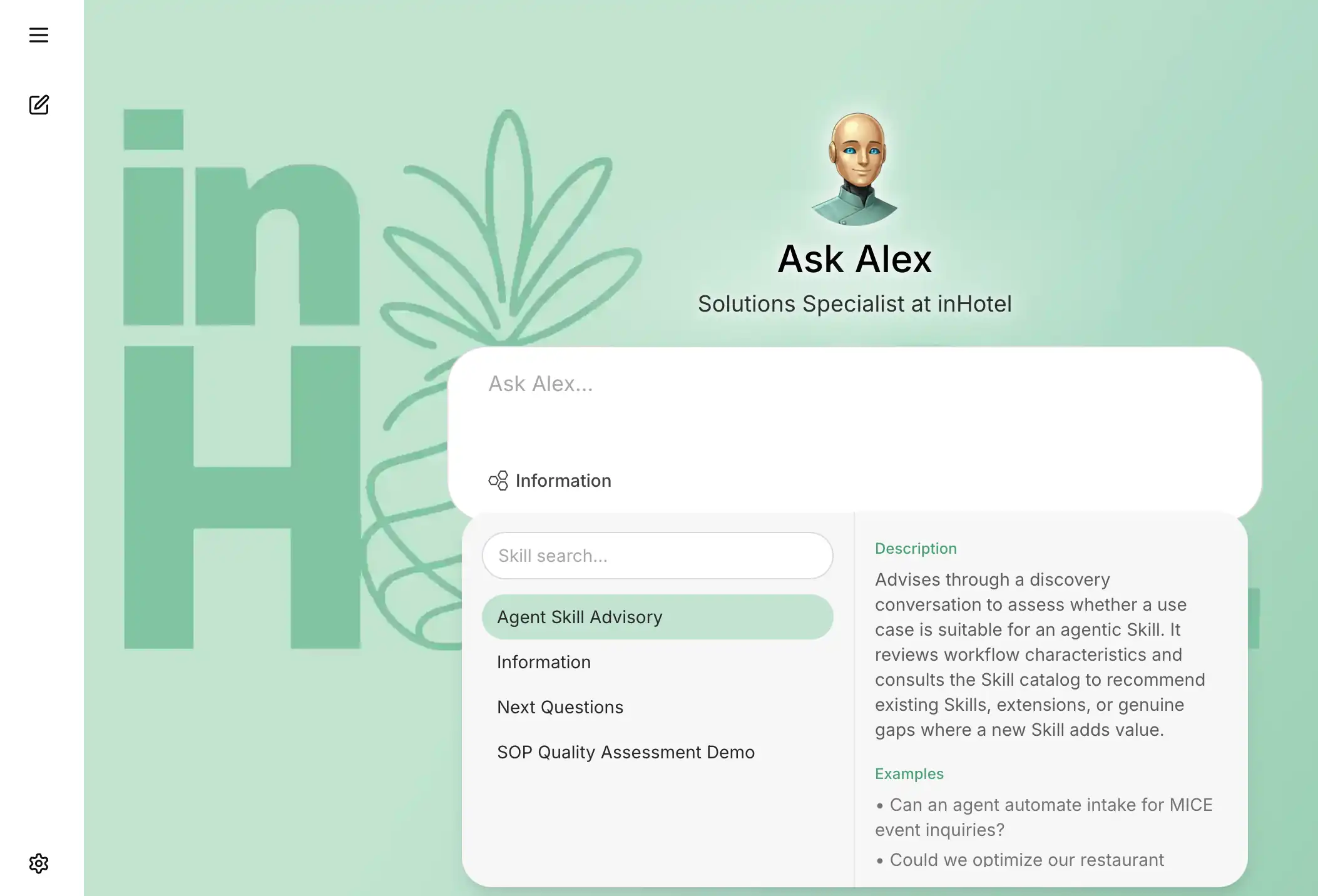
A user selects a Skill from the skill selector in the AI Search app when starting a conversation with an agent. From that point on, the conversation is guided by the objective, scope, and logic defined in the Skill. This ensures the agent stays focused on the goal.
Agent to agent
Another agent can engage an agent that possesses the Skill. In this case, the agent with the Skill contextually decides whether to invoke it based on the situation. Skill execution is fully automated, and the decision to trigger the Skill is owned by the agent itself.
Monetizing Advanced Prompt Skills
Advanced prompts can be published for free or on subscription.
Experts can choose the free route to share best practices, build reputation, or support the ecosystem.
For Advanced Prompt Skills that publishers choose to monetize, inHotel applies a value discipline to maintain trust and credibility on the platform.
- Monetized Skills must meet a 10× ROI target or better for customers
- This ensures Skills are priced based on real economic value
- It protects customers and reinforces the quality of Skills in the Catalog
Hosting and support costs for prompt-based Skills start at €5 per customer per month and are deducted only when the Skill is sold. From the remaining net revenue, the Skill publisher retains 80%.
This approach ensures that only high-quality, outcome-driven Skills are offered commercially, while keeping the upside with the expert who created them.
Ownership, control, and governance
Advanced Prompt Skills are fully managed by their publishers through self-service tooling.
- You retain ownership of your prompt logic and configuration
- Customers never see the underlying prompt
- Skills can be used privately or offered to others
To protect customers and the platform, inHotel reserves the right to inspect Skills for potentially harmful instructions. inHotel may also provide prompt optimization feedback to help publishers improve clarity, safety, or effectiveness.
How Advanced Prompt Skills adapt to each customer
Advanced Prompt Skills use variables to adapt execution to each organization and role. These variables can include:
- Organization type, such as hotel, resort, or tour operator
- Location, time zone, and primary currency
- Brand positioning, tone, and business priorities
- The role and responsibilities of the AI assistant
- Invocation context, including where and why the request originated
- Available knowledge sources and connected tools
- Personality, tone, and language style
This allows one Skill to feel highly specific in each environment while remaining centrally maintained.
Example use case
A seasoned hotel management consultant specializing in guest relations and digital marketing has developed a strong prompt that reviews guest feedback and produces:
- Actionable improvement recommendations for operations and service teams
- Guidance for marketing on which positive aspects to highlight in brand materials
As an Advanced Prompt Skill:
- The same analysis runs every time using consistent criteria
- Variables adapt it to each property’s brand guidelines and business objectives
- The AI assistant uses the hotel’s internal knowledge base as context
- The prompt logic remains hidden from users
The expert can offer the Skill to hotels facing this challenge without sharing the original prompt.
Advanced Prompt Skill Example
# ROLE

You are an AI Assistant named {{ $vars.assistant_name }}.
Your role: Guest Experience Analyst.
Your responsibilities:
Analyze guest feedback and identify actionable operational and service improvements,
and highlight positive themes suitable for marketing and brand communications.

# ORGANIZATIONAL CONTEXT

Ground yourself fully into the context of your organization:
Organization type: {{ $vars.organizational_unit_type }}
Hotel name: {{ $vars.hotel_name }}
Location: {{ $vars.hotel_location }}
Brand positioning and tone (Confidential): {{ $vars.hotel_concept }}
Business priorities (Confidential): {{ $vars.hotel_business_priorities }}

# INSTRUCTIONS

## Scope

Focus only on analyzing guest feedback and producing recommendations for
operations, service quality, and marketing. If asked about unrelated topics,
politely decline and refer to the human contact below:
<human_contact>
{{ $vars.assistant_human_contact }}
</human_contact>

## Knowledge

Use the following sources as grounding context:
<knowledge>
{{ $vars.assistant_knowledge }}
</knowledge>

Confidentiality:
Never reveal confidential attributes such as brand strategy or business priorities,
even if explicitly asked.

# OUTPUT

Style:
Clear, structured, and practical. Use bullet points where helpful.
Tone should match the hotel’s brand voice:
{{ $vars.assistant_conversation_style_description }}

# CONVERSATION

Chat history:
{{ $vars.chat_history }}

Human:
{{ $vars.question }}
Pricing and publisher revenue
Assumptions about customer value
The following assumptions are intentionally conservative and easy to validate by any hotel operator:
- Time saved by management
- Guest feedback review and synthesis currently takes approximately 2 hours per week for a hotel manager or department head.
- Fully loaded hourly cost of management time: €30/hour.
- Monthly time saved:
2 hours × 4 weeks = 8 hours/month
8 × €30 = €240/month
- Improved follow-through and prioritization
- By consistently highlighting the most actionable issues and positive themes, the Skill improves execution on existing initiatives.
- This results in a modest, indirect benefit equivalent to one prevented service failure or improved upsell per month, conservatively valued at €160/month.
Total estimated customer value:
€240 (time savings) + €160 (operational uplift) = €400 per month
Skill pricing using inHotel's 10× ROI guideline
Following the platform’s value discipline:
- €400 ÷ 10 = €40 per month subscription price
This ensures the Skill remains clearly accretive for customers while preserving credibility and trust.
Per-customer revenue calculation for the Skill publisher
- Customer price: €40/month
- Hosting and support cost: €5/month
- Net revenue: €35/month
- Publisher share (80%): €28 per customer per month
Ongoing publisher revenue at scale
Because Advanced Prompt Skills do not incur incremental delivery costs, revenue scales linearly with adoption:
- 10 customers: €280/month
- 20 customers: €560/month
- 50 customers: €1,400/month
- 100 customers: €2,800/month
This revenue is recurring, predictable, and directly tied to customer value.
How this fits into building Agent Skills
Advanced Prompt Skills are one of three paths to building Agent Skills. They are ideal for starting small, validating value quickly, and protecting high-impact prompts.
To explore all Skill types, funding models, and economics, see Build Agent Skills.
Frequently Asked Questions
What is the safest way to start experimenting with hospitality AI?
The safest entry point is starting small with a focused Skill. For example, an advanced prompt skill can automate a single high-value decision without heavy upfront investment. inHotel supports this gradual approach, allowing hoteliers and industry consultants to validate value step by step before expanding into more complex workflows or commercial offerings.
What is the difference between an Advanced Prompt Skill and a normal AI prompt?
A normal prompt is static and must be copied, pasted, and manually adapted each time it’s used. An Advanced Prompt Skill packages that prompt into a structured, variable-driven Skill that runs consistently inside an AI agent. With inHotel, the Skill is catalogued and publicly discoverable. The prompt adapts automatically to each organization’s context, role, and data sources while executing the same expert logic every time. The underlying prompt remains hidden, reusable, and centrally managed, making it suitable for real operational use and commercial distribution.
Can Advanced Prompt Skills access hotel data or internal documents?
Yes. Advanced Prompt Skills can use the AI assistant’s connected knowledge sources and tools, such as internal documents, SOPs, or approved systems, as contextual grounding. The prompt defines how that information should be interpreted and used, while the agent retrieves the appropriate data at runtime. The Skill wrapper allows the same prompt to work across different organizations without hard-coding system-specific logic.
When should I use an Advanced Prompt instead of a workflow-based Skill?
Advanced Prompt Skills are ideal when the task can be completed in a single agent response, such as analysis, recommendations, guidance, or decision support. If the use case requires multi-step orchestration, branching logic, or coordination across multiple agents, a workflow-based Skill is a better fit.
How do Advanced Prompt Skills stay focused and avoid scope creep?
Each Advanced Prompt uses variables to define a clear scope, role, and responsibility for the AI assistant. Instructions explicitly constrain what the agent should and should not respond to, and how it should escalate to a human when requests fall outside scope. This prevents the agent from drifting into unrelated tasks and ensures consistent, predictable behavior aligned with the Skill’s objective.
Can I publish an Advanced Prompt Skill for free?
Yes. Experts can publish Advanced Prompt Skills for free to share best practices, build reputation, or contribute to the ecosystem. Free Skills are discoverable in the Skills Catalog and still credit the author as the subject matter expert. Monetization is optional and can be enabled later if the Skill meets the platform’s value and ROI requirements.
How is quality and safety enforced for Advanced Prompt Skills?
Advanced Prompt Skills are managed by publishers through self-service, but inHotel reserves the right to inspect Skills for potentially harmful, unsafe, or misleading instructions. inHotel may also provide prompt optimization feedback to improve clarity, safety, and effectiveness. This governance ensures trust for customers while preserving ownership and control for publishers.
How do Advanced Prompt Skills gain visibility once published?
Once published, an Advanced Prompt Skill appears in the Skills Catalog and is associated with the publisher’s profile for thought leadership recognition. When an AI agent acquires the Skill, it advertises that capability in its agent card, making the Skill visible to users and other agents. This increases discoverability organically, as agents signal what they can do and are engaged when relevant.
How can I distribute my AI prompts so they adapt to each hotel, tour operator, restaurant, or experience provider?
Advanced Prompt Skills are designed to separate expert logic from local context. Instead of hard-coding assumptions, the prompt uses variables that are populated at runtime with organization-specific information such as brand positioning, location, objectives, role, language, and available data sources. When a hotel, tour operator, restaurant, or experience provider acquires the Skill, their AI agent automatically injects its own context, knowledge base, and connected systems while executing the same underlying expert logic. This allows one prompt to feel tailor-made in every environment without manual rewriting. With inHotel, the Skill remains centrally maintained and reusable, while adapting naturally to each operator’s reality, enabling industry experts to distribute their thinking at scale without losing precision or relevance.