

Mobile Chat
Enable guests and staff to interact with AI agents on mobile for real-time bookings, service, and support.




Mobile Chat addresses multiple challenges
Clunky agent interfaces
No access on the go
Friction for guests
Locked-in experiences
Outdated AI access
Access mobile chat via QR, NFC or links
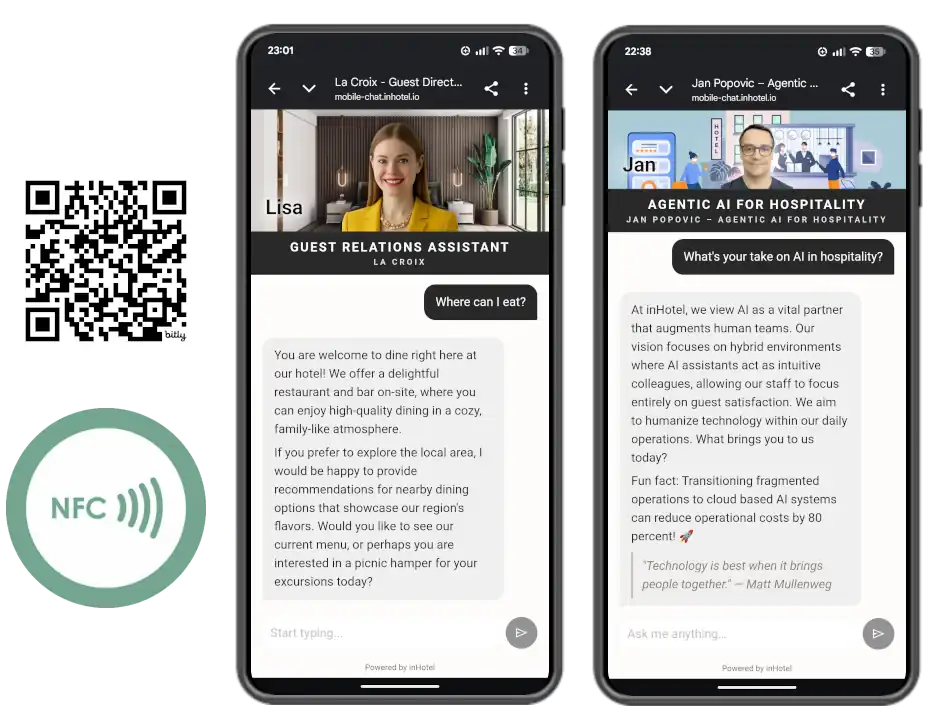
Perfect for hotels, resorts, golf courses, spas, rental providers, tourist information centers, and any destination offering on-site services and experiences.
No app. No friction. Instant access.
Let guests access information, services, and experiences on their own devices, make requests, and share feedback effortlessly. Connect them via QR, NFC, or links to AI agents in real time, without friction.
Powered by agent skills like:
- Guest Directory for instant access to property information and services
Technical Documentation


License
Business Source License 1.1
Licensor: InHotel Sàrl
Licensed Work: Mobile Chat (the “Work”)
Project Home: https://www.inhotel.io/products/mobile-chat
Additional Use Grant:
You may use, copy, modify, create derivative works of, and deploy the Work for any purpose if you are an organization whose primary business operates in the travel or hospitality ecosystem, including but not limited to: hotels, resorts, hostels, rental apartments, vacation rentals and property managers, airlines, cruise lines, travel agencies and OTAs, destination marketing organizations, GDSs, hotel technology vendors and integrators, related service providers, hotel schools and accredited higher-education institutions that offer hospitality or tourism programs, including use by their faculty, staff, and enrolled students for classroom, research, and pilot deployments.
Prohibited Use:
Any use outside the scope above without a separate commercial license fromthe Licensor.
Change Date: 2026-04-03
Change License: Apache License, Version 2.0
All other terms are per the standard Business Source License 1.1.
Frequently Asked Questions
What is the easiest way for guests to access a hotel AI agent on their mobile?
The simplest setup is one where guests don’t need to install anything at all. Think QR codes on a room key card, a small NFC tag at reception, or a link sent via SMS. Scan or tap, and the chat opens instantly in the browser. No app store. No login friction. This matters more than most vendors admit. Guests rarely download hotel apps for short stays, and even when they do, they don’t return. A lightweight mobile chat interface solves that problem. It feels like texting, not using a system. Behind that simple interface, skilled AI agents can answer questions, handle requests, or guide bookings. From the guest’s perspective, it’s just fast and convenient. From your side, it removes a huge adoption barrier.
Can mobile AI chat handle guest requests like housekeeping or room service?
Mobile AI chat can handle requests like housekeeping or room service when connected to the right AI agents behind the interface. The chat is simply how guests interact, while execution depends on the skills of the agent you choose. For example, a guest can type “I need extra towels” or “Can I order breakfast?” and a Guest Relations Assistant with the right skills will interpret the request, confirm details, and handle it internally. This gives you real flexibility. You can start simple and expand over time by selecting agent skills from a catalog for service requests, bookings, or operations. The guest experience stays consMobile AI chat can handle requests like housekeeping or room service when connected to the right AI agents behind the interface. The chat is simply how guests interact, while execution depends on the skills of the agent you choose. For example, a guest can type “I need extra towels” or “Can I order breakfast?” and a Guest Relations Assistant with the right skills will interpret the request, confirm details, and handle it internally. This gives you real flexibility. You can start simple and expand over time by selecting agent skills from a catalog for service requests, bookings, or operations. The guest experience stays consistent, while you control exactly what the system can do.istent, while you control exactly what the system can do.
How do mobile AI tools improve guest engagement compared to traditional hotel apps?
Traditional hotel apps struggle because they ask too much upfront. Download this. Create an account. Learn how it works. Most guests simply won’t bother. Mobile chat flips that. It meets guests where they already are, on their phone, in a familiar interface. Scanning a QR code feels effortless. Typing a question feels natural. That small shift changes behavior. Guests engage more often, ask more questions, and discover more services. Instead of guessing what’s available, they explore by asking. That leads to higher usage of amenities, more pleasant stays, and better reviews. It also reduces pressure on your staff, since many questions never reach the front desk. Engagement goes up not because the tech is smarter, but because it’s easier to use.
What are the cost implications of using mobile AI chat instead of a custom app?
Building and maintaining a custom app is expensive, and most operators never see a return on that investment. You pay for development, updates, bug fixes, and ongoing support, then still need to convince guests to download it. A mobile chat approach removes most of that overhead. The interface runs in the browser, so there’s nothing to install or maintain on the guest side. Your cost shifts toward the intelligence layer, the AI agents and their skills that actually deliver value. That’s where the real impact is. You’re investing in better service and operations, not maintaining software. It also scales more naturally. Whether you run one property or many, you reuse the same mobile access points and simply evolve the agents behind them.
How do you keep AI responses accurate and up to date in a mobile chat system?
Accuracy comes down to how the underlying agents are managed. A good setup lets you update information in one place and have it reflected instantly in every conversation. Change breakfast hours, update a menu, adjust a policy, and it’s live right away. No waiting for app updates or reprinting materials. It’s similar to updating a website, but more conversational. The system should also guide responses based on structured knowledge, not guesswork. That means fewer hallucinations and more reliable answers. Over time, you can refine how the agent responds based on real guest questions. You see what people actually ask, not what you assumed they would. That feedback loop is what keeps the experience sharp.
How much does mobile AI chat for travel and hospitality cost?
Mobile chat is available for free to companies across the travel and hospitality industry, whether you run hotels, tours, rentals, or destinations. You can launch quickly using free AI assistants and basic agent skills, which are enough to get started and deliver real value to guests. This makes it easy to test the experience without upfront cost or commitment. Over time, many operators choose to invest in more advanced assistants and specialized agent skills to improve service quality, automate operations, and drive additional revenue. The mobile interface remains free, so your investment stays focused on the parts that actually make a difference to guests and staff.
Can we change or upgrade AI agents powering mobile chat without replacing QR codes or links?
Yes, and this is one of the biggest practical advantages of a mobile chat setup. Your access points, QR codes, NFC tags, and links, stay exactly the same, while the AI agents behind them can evolve. You might start with a basic setup that answers common questions, then later introduce more advanced agent skills that handle bookings, requests, or operations. All of that happens without reprinting materials or updating anything on-site. The guest experience remains consistent, while the capabilities improve over time. This gives you flexibility to test, adjust, and upgrade without disrupting daily operations. Instead of committing to a fixed system, you can adapt as your needs change and as better agent capabilities become available.
How can I connect to an A2A-compatible AI agent from a mobile?
You can connect to an A2A (Agent-to-Agent) AI agent on mobile using a simple web-based chat interface: Mobile Chat. It runs in the browser, so users just scan a QR code, tap an NFC tag, or open a link, and the conversation starts instantly. The key is the Agent Card URL (https://[domain]/.well-known/agent-card.json), which you pass as an `agent_card_url` parameter. This tells the mobile chat which A2A agent to connect to. You can also shape the experience. Add a `skill_name` parameter to trigger a specific capability, such as guest directory or service requests. Include `source_channel` to indicate where the user came from, like a spa entrance or hotel room QR code, so the agent can respond with the right context. The mobile AI chat interface is optimized for phones and available at no cost for travel and hospitality businesses.