AI Agent API Tool Connector for Hospitality Integrations
A unified AI agent tool connector for hospitality that securely scales API integrations, governance, and real-time system access.


AI Agent API Integration Challenges in Hospitality
AI co-pilots and virtual assistants are only as useful as the systems they can actually work with. In hospitality, that means real access to live, operational data. Occupancy, rates, restaurant menus, weather forecasts, city events, maintenance tickets. All of it changes constantly, and all of it lives across multiple systems.
A hotel website bot that cannot answer availability or weather questions is not helpful.
Large language models on their own cannot solve this. They are limited to static training data and have no native ability to interact with external systems such as SaaS tools or APIs. AI agents change that. They can use external tools and connect to OpenAPI- or MCP-based systems.
In this context, a tool is a structured API action with a defined schema and execution contract that an AI agent can autonomously select and invoke to interact with external systems.
The challenge is no longer whether this is possible. The challenge is making it scalable, reliable, and governable in real production environments.
Why Direct API Integrations Fail for Agents
When we (Azam and Jan) started building hospitality AI agents back in 2024, we took the obvious approach. We connected APIs one by one. This worked reasonably well at first. Then we reached roughly the tenth integration, and things started to break down. We encountered a set of problems that consistently appear once agentic systems move beyond experimentation:
- API endpoint descriptions that collectively exceeded context window limits.
- Agents struggling to select the correct endpoint when multiple similar tools were available.
- Diverging authentication models, token lifetimes, scopes, and call semantics across services.
- API specifications whose quality directly influenced agent reliability and decision-making.
- Schema inconsistencies and undocumented edge cases requiring manual intervention.
- Inability to enforce critical grounding variables, such as Property ID.
- Fragile glue code that had to be adjusted for every new integration.
- Growing difficulty understanding and debugging agent decisions as tool counts increased.
These cases appeared immediately once we tried to scale beyond a handful of integrations.
Enterprise AI Agent Tools Middleware
What our hospitality customers needed was a robust Tool Manager designed specifically for agentic operating systems. And so we built it. Today, we are opening access to an enterprise-grade agent tool management system to our customers and partners. 🎉
At a high level, this layer provides guarantees across three dimensions.
Agent Management
- Centralized control over which tools are allowed within an organization.
- Custom tool selection per agent (assistant).
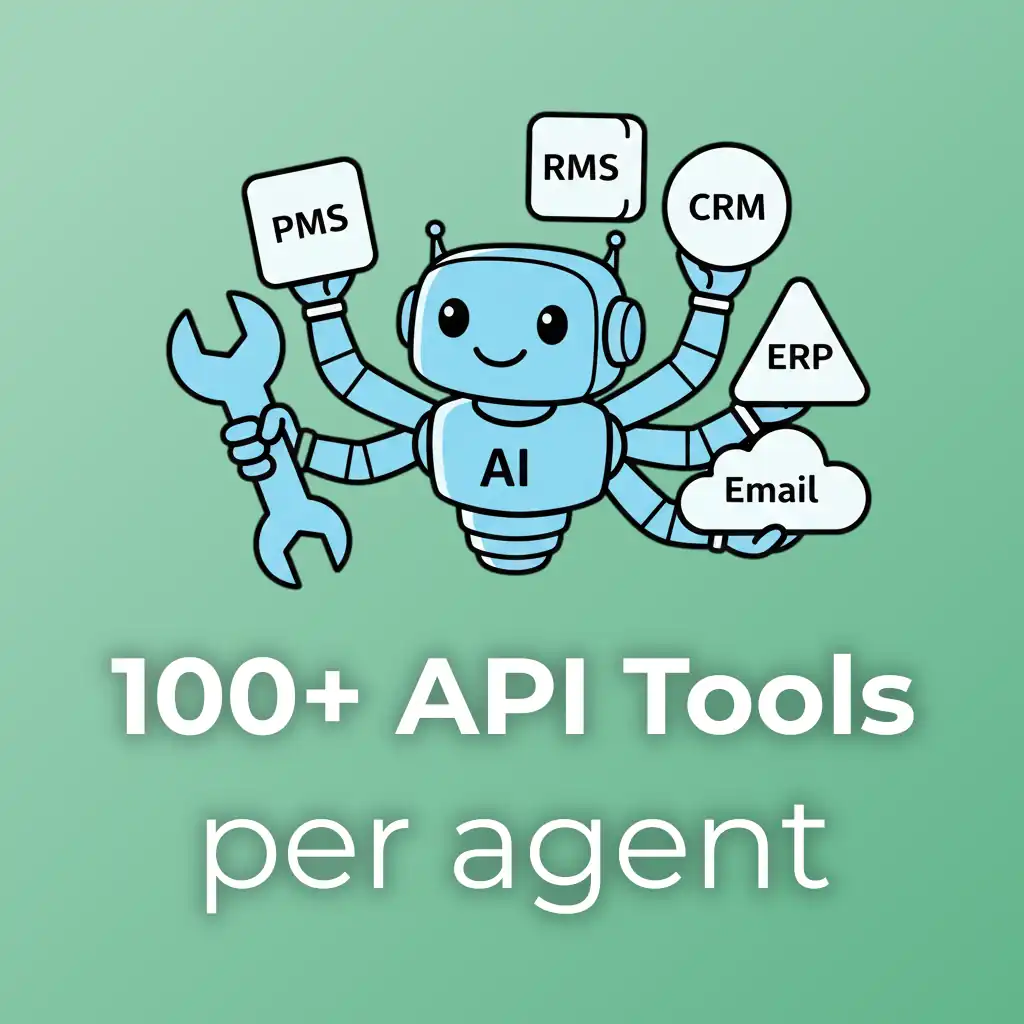
- The ability to scale to dozens or even hundreds of tools per agent without confusing them.
- Support for real actions, such as updating systems, triggering workflows, or retrieving live operational data.
Security and Compliance
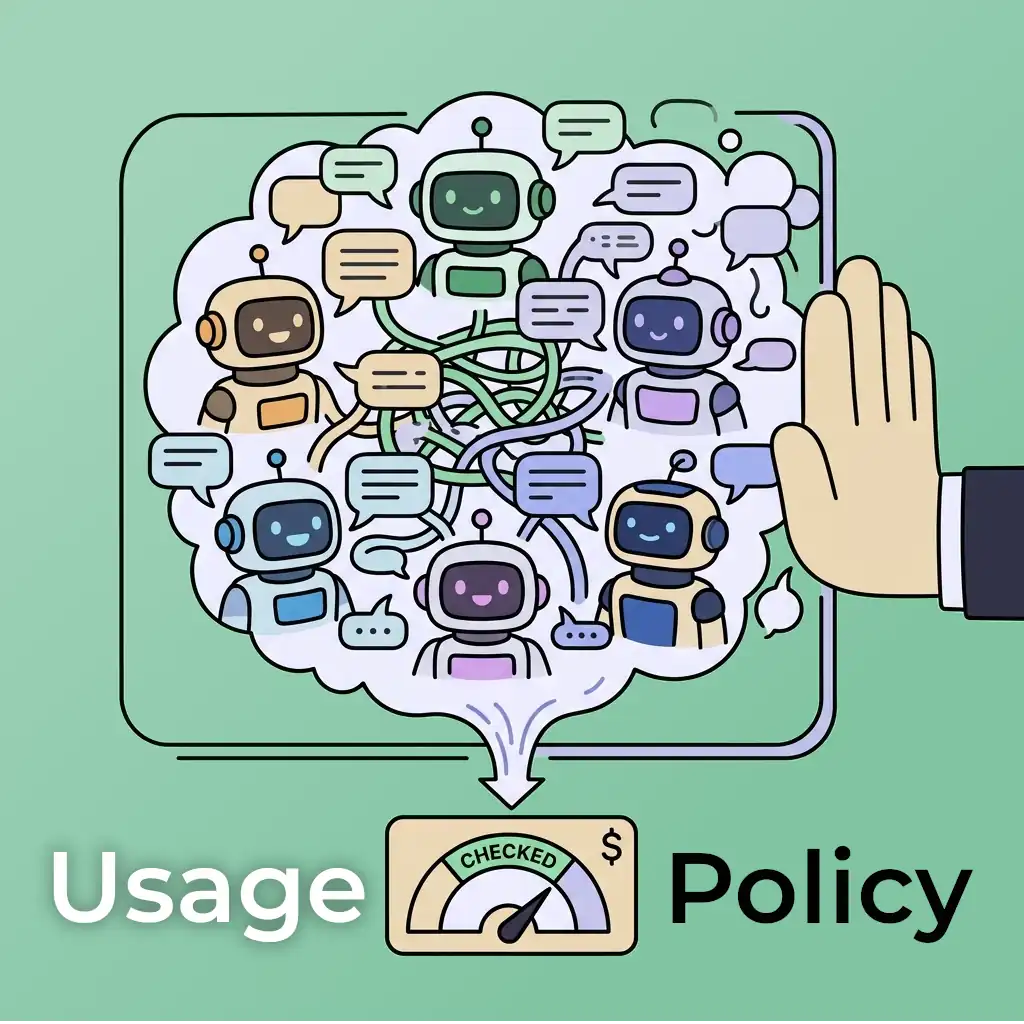
- Enterprise-grade access management, logging, and observability.
- Customer-managed credentials, connections, and permissions.
- Secure handling of authentication patterns such as OAuth2 and API keys, with automated token refresh and isolation from agents themselves.
Operational Efficiency
- A semantic bridge between low-level machine actions and business-level language through consistent documentation.
- Normalized action descriptions that allow systems like PMSs to be replaced without changing operational procedures.
- No bespoke glue code per integration.
- API onboarding measured in hours rather than weeks.
Solving AI Agent API Governance and Scalability Challenges
The core problems the API Tools Connector solves:
Making AI Agents Useful in Real Workflows: Agents can now operate directly on live systems instead of reasoning in isolation. This is what turns conversational interfaces into operational assistants.
A True Unified Integration Layer: All tools are exposed through a consistent interface, regardless of vendor, schema design, or authentication model.
Automated Authentication and Token Management: Secure connections to third-party systems are handled through built-in authentication flows, credential storage, and automated token refresh. This removes manual integration work and reduces operational risk.
Visibility and Control Over Agent Decisions: Every tool invocation is observable. Actions, parameters, and execution paths are logged and traceable, enabling debugging, governance, and compliance as agents become more autonomous.
How AI Agents Infer and Execute API Actions
Traditional API integrations rely on SDKs, manual parameter definitions, and defensive code paths.
With inHotel’s Tools, agents infer how to use integrations without pre-coded handlers. There is no need to modify application code or rewrite prompts when adding or replacing integrated systems.
For example, when an agent needs to retrieve occupancy data, it can infer that this information is available in the PMS, determine the appropriate action to call, and execute it correctly. If the underlying PMS is replaced, the agent can continue to handle the same task through the normalized tool, without requiring changes to agent logic, prompts, or workflows.
This is what makes the platform scalable.
Protocol Support and API Quality
The Connector provides robust support for OpenAPI-based agent tools, enabling reliable integration between agent frameworks and real-world hospitality systems. While the architecture is extensible to MCP, we have prioritized OpenAPI-based integrations to meet immediate production and scalability requirements.
API quality is a first-order concern in agentic systems. Poorly described actions, ambiguous parameters, or inconsistent error handling directly impact agent reliability. To address this, the Connector includes an agentic workflow to assess API specifications and ensure that only integrations meeting reliability standards are exposed to customer-facing assistants.
An API Gateway for AI Agents
Hospitality technology has long relied on dense networks of point-to-point integrations. Over time, this creates systems that are difficult to evolve and even harder to scale.
Agentic systems allow for a different approach.
The inHotel Tool Connector functions as an API gateway designed for AI agents rather than human clients. It centralizes, secures, and abstracts access to multiple systems, while enabling agents to reason about available actions and operate across them autonomously.
By normalizing tools instead of hard-wiring integrations, agents can orchestrate workflows across systems that were never directly integrated with each other. The result is an architecture that is scalable, maintainable, and capable of supporting AI as an operational layer across the full hotel stack.
API Tool Integration Pricing
In an agentic world, limiting API access is equivalent to selling software without interfaces. We consider charging per integration an outdated business model.
Every assistant on our free Discover plan includes access to one API tool. Paid plans progressively increase limits, up to unlimited connected APIs on the Ultimate assistant plan.
Example Use Cases
Enhancing Guest-Facing Assistants
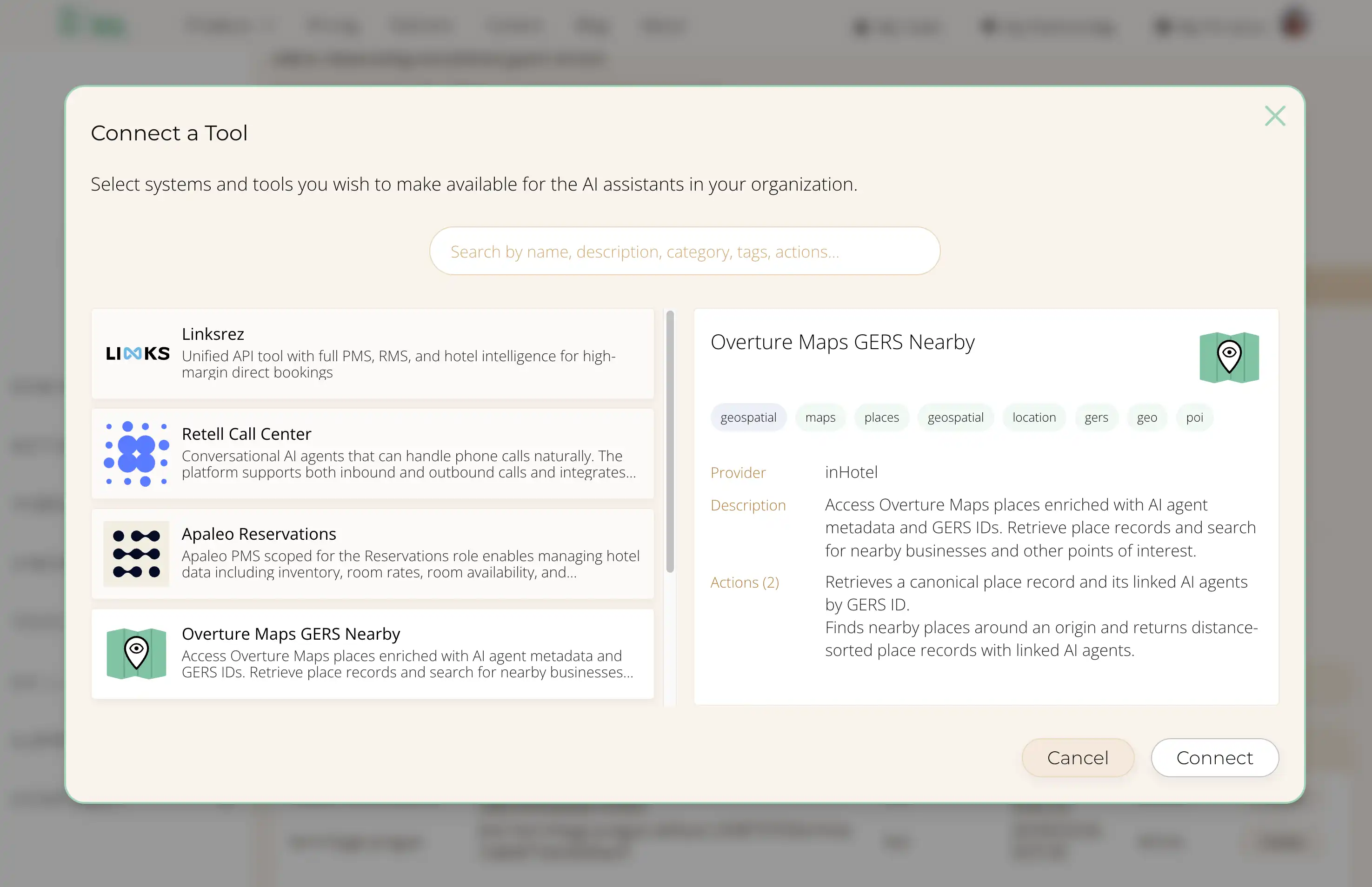
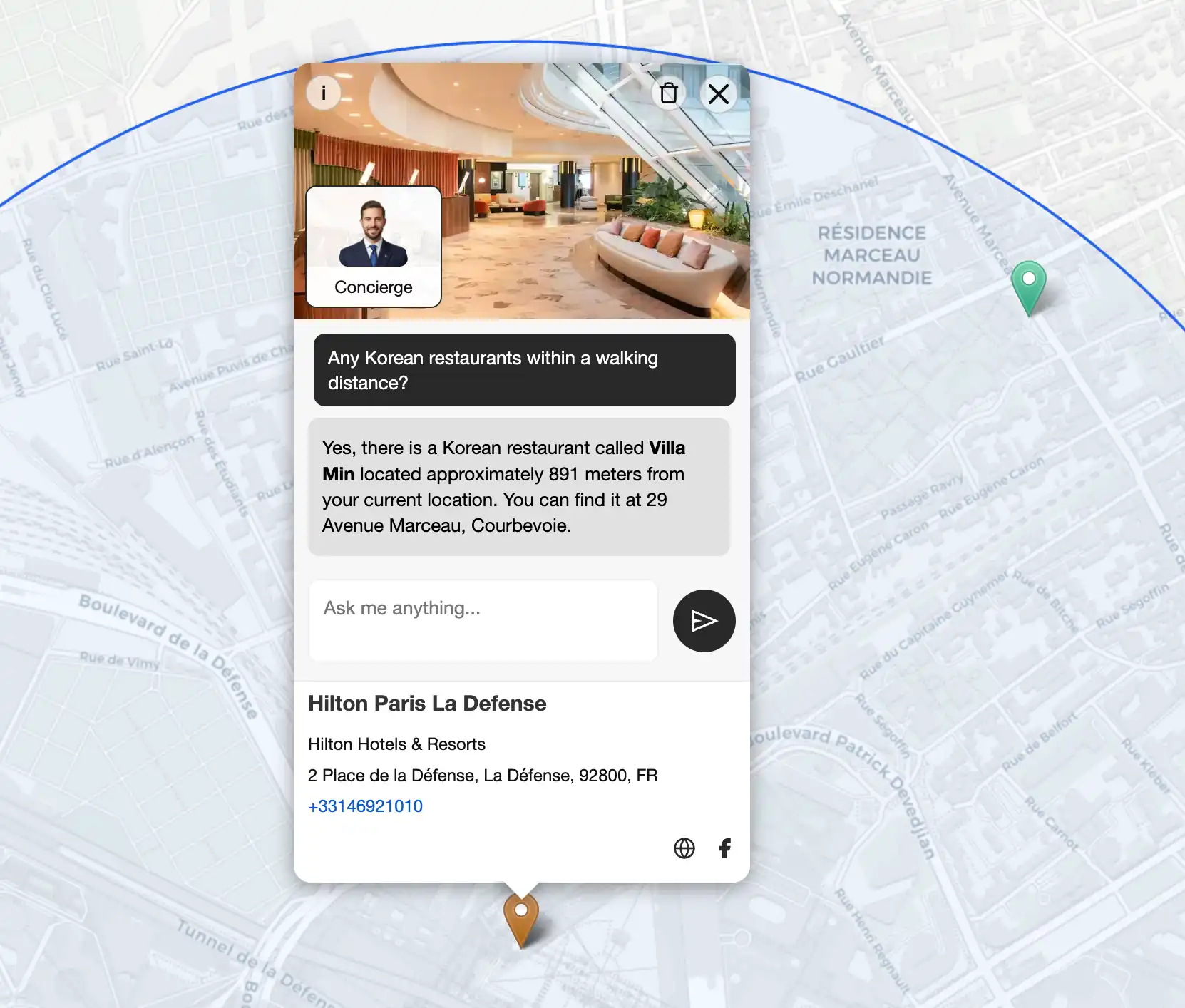
A hotel enables its Reservations, Guest Relations and Concierge assistants to recommend nearby restaurants and attractions by connecting a location data GERS API. The tool is enabled once and connected to assistants with a few clicks. No code. No prompt changes.
Chatting Directly with a PMS
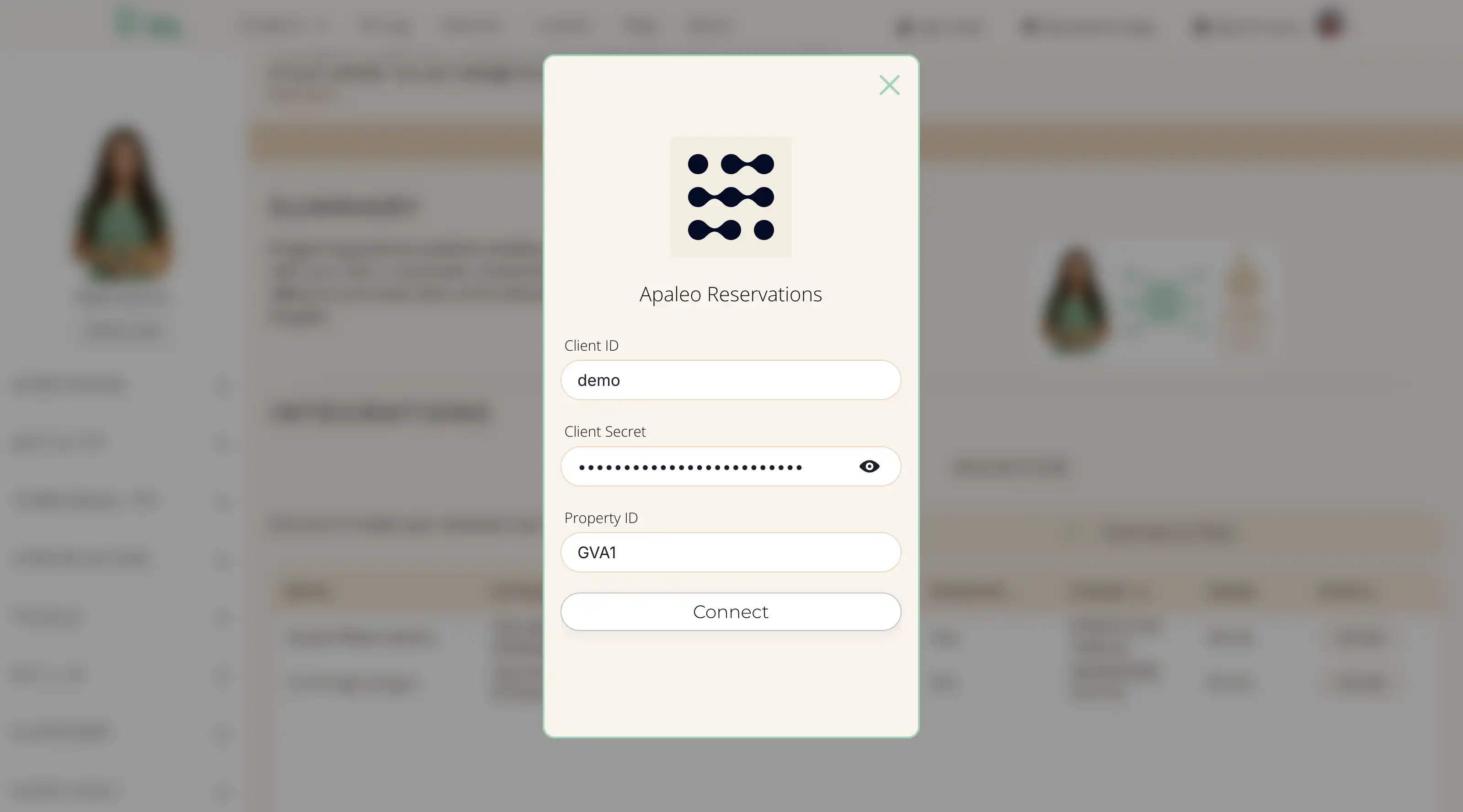
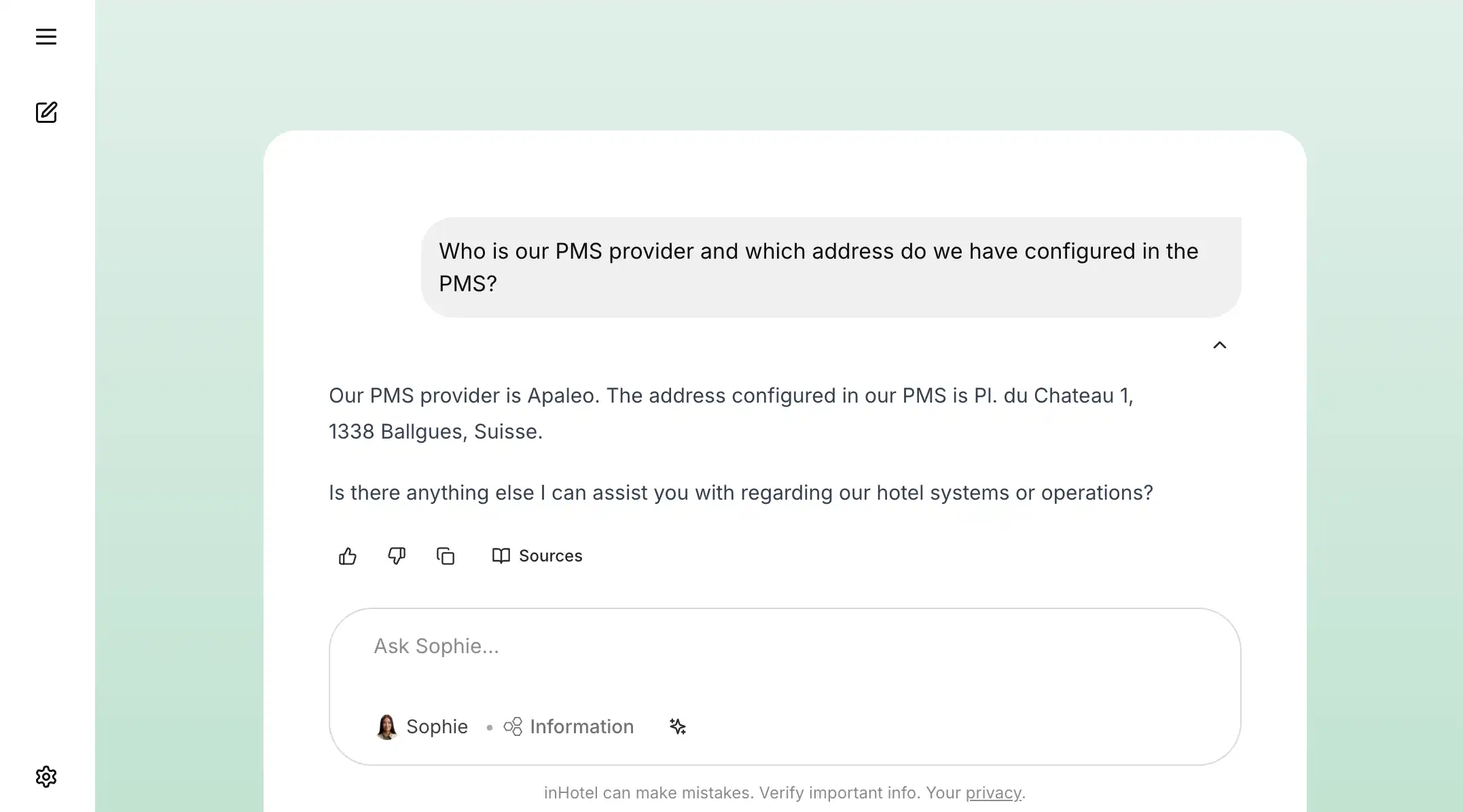
A general manager interacts conversationally with an OpenAPI-enabled PMS, such as Apaleo.
The assistant is connected to the PMS with a defined scope and grounded using a Property ID in a multi-property setup. The GM can now work directly with live PMS data through their AI assistant.
The Future of Self-Service AI Agent API Integrations
Our long-term goal is fully self-service API onboarding for technology partners.
The main constraint today is API quality across parts of the hospitality ecosystem. Traditional integrations tolerated ambiguity by encoding assumptions into rigid code. Agentic systems cannot.
We are building agent-assisted workflows to evaluate API quality, gate unreliable integrations, and continuously monitor performance over time.
More on that soon.
In the Meantime
For travel and hotel tech providers with Open APIs
If you want to augment your product offering with a cutting-edge agentic system for hospitality operators, let’s talk.
For hoteliers and operators in travel and hospitality
If you want your staff and AI agents to interact naturally with your API-enabled systems while maintaining strong security and compliance guarantees, use our universal API Tool Connector.
Frequently Asked Questions
What is an AI agent tools API connector in hospitality?
An AI agent tools API connector is middleware that allows AI agents to securely access and operate hotel systems such as PMS, CRS, CRM, RMS, or external data providers through structured tools. In hospitality, this is critical because operational data changes constantly and lives across many systems. inHotel’s solution provides a unified layer where APIs are exposed as normalized tools that agents can reason about and invoke autonomously, without custom code per integration.
Why can’t AI agents connect directly to hotel APIs without middleware?
Direct API connections do not scale well for AI agents in hospitality. LLM context limits are quickly exceeded when agents are exposed to dozens of endpoints, parameters, and variations. Hotel systems use different schemas, authentication models, scopes, and call semantics, and API specifications often vary widely in quality. As integrations grow, fragile glue code, manual authentication handling, and unclear API behavior become major blockers to reliability and governance. inHotel’s agent tool connector solves this by acting as middleware between agents and hotel systems. It abstracts schema and authentication differences, normalizes agent actions, manages credentials and token refresh, and provides logging and control. This allows AI agents to interact reliably with multiple hospitality systems in real production environments without being overwhelmed.
How does an AI agent multi-tooling solution scale across many hotel systems?
Scalability comes from centralizing integrations and normalizing how actions are described and executed. Instead of each agent handling dozens of APIs directly, inHotel’s solution allows agents to select from an allowed set of tools defined by administrators. This prevents confusion, reduces context overload, and enables agents to scale to dozens of API-based tools with hundreds of endpoints while remaining reliable and predictable.
How is authentication and security handled for AI agent tools?
Secure authentication is managed at the connector layer, not by the agent itself. inHotel’s solution supports common enterprise patterns like OAuth2 and API keys, with secure credential storage and automated token refresh. Agents never interact with secrets directly. This reduces security risk, simplifies compliance, and ensures stable long-running agent workflows across hospitality systems.
How do AI agents decide which API or tool to call for a task?
Agents rely on structured tool definitions with clear schemas and descriptions. inHotel’s connector normalizes these definitions so agents can reason about available actions semantically rather than guessing between raw endpoints. For example, when an agent needs occupancy data, it can infer that the PMS tool provides it and execute the correct action, even if the underlying system changes.
What governance and observability features are needed for AI agent tools?
As agents become autonomous, visibility is essential. inHotel’s solution provides action logging, parameter traceability, and audit trails for every tool invocation. This allows IT teams to understand what agents did, why they did it, and with which data. These controls are critical for debugging, compliance, and operational trust in hospitality environments.
How does API quality impact AI agent reliability in hospitality?
AI agents depend heavily on clear API descriptions, logical parameters, and predictable error handling. Poor OpenAPI specs directly degrade agent behavior. inHotel addresses this by assessing API specification quality and gating unreliable integrations, ensuring only tools that meet reliability standards are exposed to agents used in guest-facing or operational workflows.
Is an AI agent tool connector similar to an API gateway?
Conceptually yes, but with an important distinction. Traditional API gateways are built for human-developed applications. inHotel’s connector functions as an API gateway designed for AI agents. It not only secures and centralizes access, but also enables agents to reason about actions and orchestrate workflows across systems that may not be directly integrated with each other.
What pricing models make sense for AI agent API integrations?
Charging per API integration is increasingly misaligned with agentic systems, where agents act as operational interfaces. inHotel follows a model where assistants include access to a baseline number of tools, with higher plans expanding limits up to unlimited integrations. This approach reflects how agents actually create value and avoids artificially restricting automation in hospitality operations.
How to integrate AI agents with hotel system APIs?
Integrating AI agents with hotel APIs requires more than simply exposing endpoints to a language model. Hotel systems such as PMS, CRM, and RMS use different schemas, authentication models, and documentation standards, which can quickly overwhelm agents and create fragile integrations. A scalable approach involves introducing a middleware layer that normalizes APIs into structured tools with defined schemas and execution contracts. In inHotel’s solution, hotel APIs are abstracted into agent-ready tools with managed authentication, automated token refresh, governance controls, and action logging. This allows AI agents to autonomously select and invoke the correct action, such as retrieving occupancy data or updating reservations, without custom glue code or prompt rewrites, even if the underlying hotel system changes.