Prophet Time Series Forecasting for Hospitality AI Agents
Meta’s open-source Prophet time-series forecasting for AI agents helps hospitality teams predict occupancy, demand, revenue, costs, staffing, and F&B needs.


Why Hospitality Forecasting Belongs in AI Agents
Forecasting is one of the most valuable habits in hotel management. It is still too often trapped inside spreadsheets, revenue management systems, BI dashboards, or specialist analyst workflows. That creates a quiet problem: the people making day-to-day decisions often need a forecast before they can act, yet the forecast is frequently missing at the moment of decision.
Today, we are making Prophet Time Series Forecasting tool available for free to all inHotel assistants and agents.
The tool predicts a future value from historical time series data. A hotel employee or an AI agent provides date-and-value history, such as occupancy by stay date, revenue by day, breakfast covers by morning, or staffing demand by shift, plus a target date. An AI agent with the tool returns a forecasted value with lower and upper confidence bounds.
Forecasting belongs wherever hotel teams make decisions.
Imagine a 90-room independent hotel with an API-enabled PMS and without a specialized BI platform or an RMS. The hotel connects its AI assistant to the PMS and asks: "What occupancy should we expect next month?" The assistant can use historical occupancy, pickup, and Business on the Books data to run a forecast and return a practical range for the team to discuss.
Hotel work is full of questions that are really forecasting questions:
- Will occupancy on this date be high enough to displace transient demand?
- How much group business should we expect to wash?
- What staffing level will next Friday require?
- How many breakfast covers should the kitchen prepare for?
- Is this revenue forecast realistic compared with past seasonal patterns?
Prophet Time Series Forecasting gives hotel AI assistants a practical way to answer those questions from historical data, with uncertainty clearly visible.
Key Takeaways
- Prophet Time Series Forecasting is now available to inHotel assistants and agents.
- Any authorized agent can use date-and-value history plus a target date to forecast a future hotel metric.
- The tool returns a forecasted value with lower and upper confidence bounds, which makes uncertainty visible.
- The first inHotel use cases are Hotel Group Sales and Hotel Group Displacement.
- The same forecasting method can support occupancy, demand, revenue, staffing, F&B demand, purchasing, food waste, and budget conversations.
- Hotels with only a PMS can use Prophet forecasting for many practical questions before investing in specialized BI or RMS software.
- Prophet Time Series Forecasting is available for free to inHotel assistants and agents.
- inHotel is committed to applying proven open-source technologies in practical ways that help hoteliers reduce software cost and improve daily decisions.
- The tool uses Meta's open-source Prophet project and applies it inside practical hospitality workflows.
How Prophet Time Series Forecasting Works for Hotels
The inHotel tool is simple by design.
Input: historical time series data with dates and values, plus a target date.
Output: a forecasted number, lower confidence bound, and upper confidence bound.
For example, a hotel assistant could send historical occupancy values from the PMS Business on the Books report and ask for the expected occupancy for a future stay date. The assistant receives a directional forecast and a confidence range that can be used in a group sales, displacement, staffing, or planning workflow.
This is a structured analytical tool that an agent can call when it needs quantitative judgment.
Why inHotel Uses Meta Prophet Forecasting
Prophet is an open-source forecasting project originally released by Facebook's Core Data Science team. The official Prophet documentation describes it as a forecasting procedure for time series data that models non-linear trends with yearly, weekly, and daily seasonality, plus holiday effects. It is designed to work well with time series that have strong seasonal effects and several seasons of historical data, and it is robust to missing data, trend shifts, and outliers.
That shape fits many hotel problems. Demand changes by weekday. Resorts move with seasons. City hotels react to business travel cycles, events, holidays, and booking pace. Group-heavy hotels need to compare long lead-time commitments with later transient demand.
Prophet works best when teams value explainable seasonality, trend visibility, and practical forecasting workflows. Rob Hyndman and George Athanasopoulos, authors of Forecasting: Principles and Practice, describe Prophet as a non-linear regression model that separates trend, seasonality, and holiday effects. They also note that alternative forecasting methods can outperform Prophet on accuracy in some situations. That is the right framing for hotels too.
We chose Prophet because it is explainable enough for practical business use, strong at seasonal decomposition, and well suited to being used by agents that need a fast, structured forecast.
Every hotel assistant should have access to a responsible forecast when the workflow needs one.
Why Forecast Confidence Bounds Matter in Hotels
A single forecast number can be dangerous.
If an assistant says, "Expected occupancy is 82%," a manager may treat that number as a fact. In reality, forecasts are estimates. A better answer is: "Expected occupancy is 82%, with a lower bound of 74% and an upper bound of 89%."
That range changes the decision. A group sales agent evaluating a low-rated group might accept the business if the lower bound suggests weak transient demand. The same agent might ask for a higher rate, smaller block, or stricter release terms if the upper bound suggests a realistic risk of displacement.
Responsible forecasting makes uncertainty visible enough to manage.
Hotel Group Sales and Displacement Forecasting
The first immediate inHotel use cases are two skills we are developing:
Both depend on forecasting. A group request is both a sales opportunity and a capacity decision. If a hotel accepts a discounted group too early, it may block rooms that could later be sold to higher-rated transient guests. If it rejects too many groups, it may lose base occupancy, meeting space revenue, F&B revenue, and shoulder-night compression.
Cornell research by Sheryl E. Kimes found that group forecasts can be materially inaccurate far from arrival. In a study of approximately 90 North American hotels, group forecast error averaged about 40% MAPE two months before arrival, about 30% one month before arrival, and 10% to 15% on the day of arrival. The same paper found that group forecasts showed positive bias and that more frequent forecast updates close to arrival were associated with lower forecast error.
Although the Cornell study was published in 1999, the underlying group-sales problem remains familiar to hotels today: groups book far in advance, pickup changes over time, and inaccurate forecasts can distort displacement decisions. The specific error rates should be read as historical evidence of the problem, while the business lesson remains current.
That is exactly where an agentic forecasting tool becomes useful. A hotel group sales assistant can use PMS and Business on the Books data to forecast expected occupancy for the requested dates, while a displacement assistant can compare:
- Forecasted transient demand
- Expected group room revenue
- Group wash patterns
- F&B and meeting space contribution
- Variable costs and commissions
- Confidence bounds around the forecast
In these first skills, Prophet Time Series Forecasting applies weekly and annual seasonality patterns detected from PMS Business on the Books data and related hotel reports, then returns the occupancy forecast in a form the assistant can use inside the group decision.
The decision still belongs to the hotel. The agent simply brings better math to the moment.
For many PMS-based forecasting questions, an open-source Prophet tool can give hotels useful forecasts before they invest in a separate BI or RMS product.
Hotel Forecasting Beyond Revenue Management
HSMAI describes hotel forecasting as a sequence of demand, strategic, revenue, and operational forecasts. In that framework, the demand forecast is the baseline for rates, availability, and restrictions. The operational forecast then gives departments the information they need to prepare their areas of responsibility.
That is the larger opportunity.
Hotels have treated forecasting as a revenue management discipline for good reason. Rooms are perishable. Pricing matters. Occupancy drives performance. But the same forecasting habit helps many other departments prepare with less guesswork.
This is why we see forecasting as a platform capability across commercial and operational teams.
F&B Forecasting, Purchasing, and Food Waste
F&B is a good example of why forecasting should be available beyond the revenue office.
IDeaS has argued that F&B can account for up to 50% of revenue in some hotels, while remaining much harder to forecast than rooms because data is spread across restaurants, catering, room service, mini bars, packages, and shared costs. That complexity is exactly why hotel assistants need analytical tools that go beyond natural-language answers.
Food waste is another practical case. WWF, Greenview, AHLA, and the Cornell Hotel Sustainability Benchmarking Index reported that hotels account for roughly 3% of global food waste, that food waste represents approximately 8% of total food costs in hotels, and that case studies found hotels can reduce 40% of waste in six months by measuring and managing it. The same WWF article notes that every $1 invested in food waste reduction returns $7 on average for hotels.
Forecasting helps a kitchen assistant connect occupancy, group profiles, breakfast patterns, banquet guarantees, and historical outlet demand before food is ordered or prepared.
For a hotel kitchen or F&B leader, the forecast could support work such as:
- Flagging that next Tuesday's breakfast demand is likely below the same week last year.
- Estimating banquet overproduction risk from historical no-show and wash patterns.
- Helping purchasing teams avoid ordering as if every high-occupancy day behaves the same.
- Giving F&B leaders an early warning when outlet demand is likely to diverge from rooms occupancy.
The value appears in better prep before the waste happens.
How Hotel AI Agents Use Forecasting Tools
Prophet Time Series Forecasting can be used by any agent or assistant that has access to appropriate historical data and permission to call the tool. For inHotel users, the most immediate data sources are PMS reports, Business on the Books, pickup, occupancy, revenue, and other operational reports that can be represented as date-and-value pairs.
A typical workflow looks like this:
- The assistant identifies that the user's question requires a forecast.
- It collects the relevant historical time series, such as occupancy by stay date.
- It sends the time series and target date to Prophet Time Series Forecasting.
- It receives the forecasted value plus lower and upper confidence bounds.
- It explains the result in hotel language and ties it back to the decision.
Example PMS Forecasting Workflow Inside an AI Assistant
Here is a live example of an inHotel assistant using the Prophet Time Series Forecasting tool with PMS Business on the Books data. The assistant receives historical date-and-value data and forecasts future ADR and occupancy.
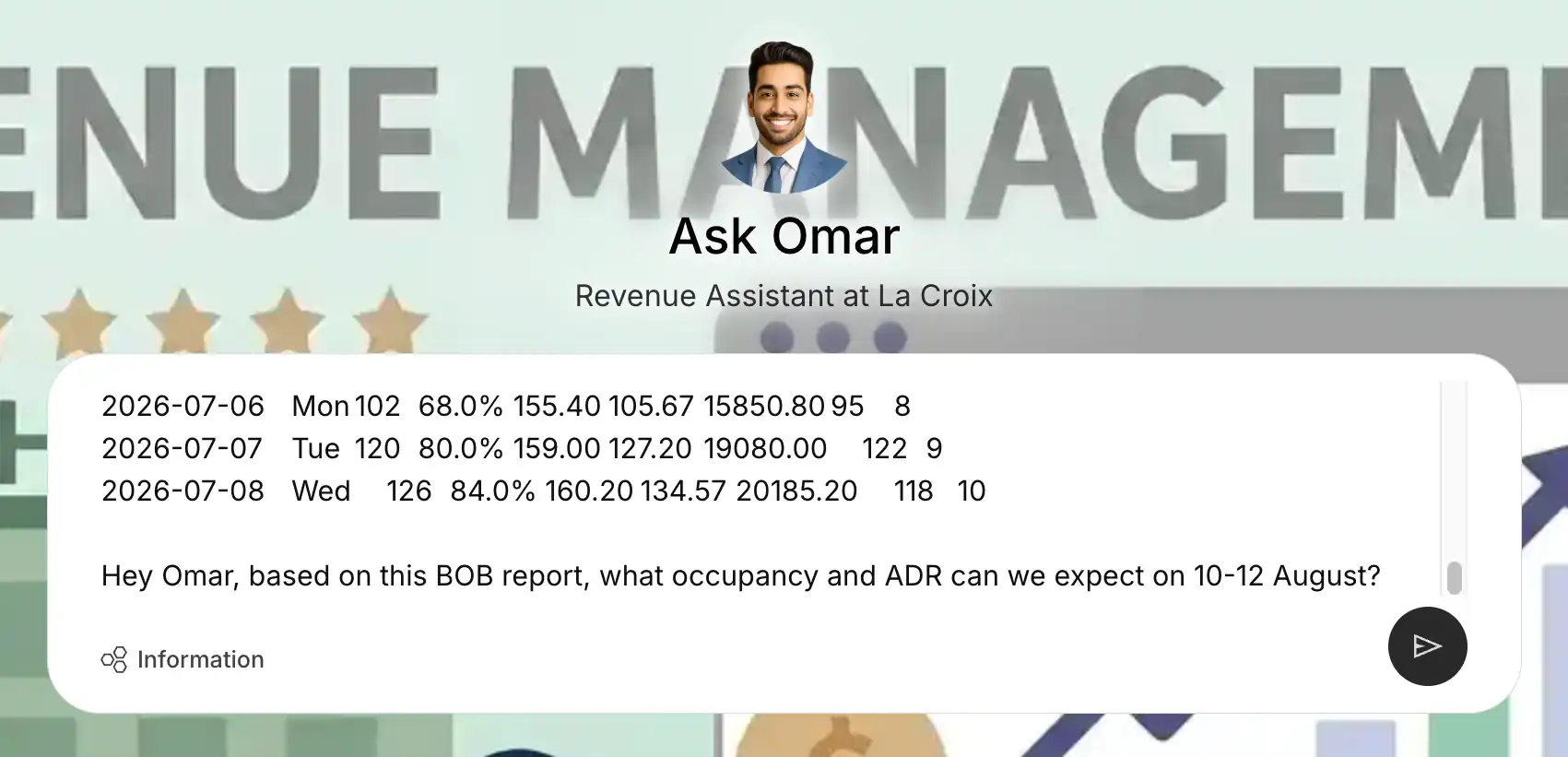
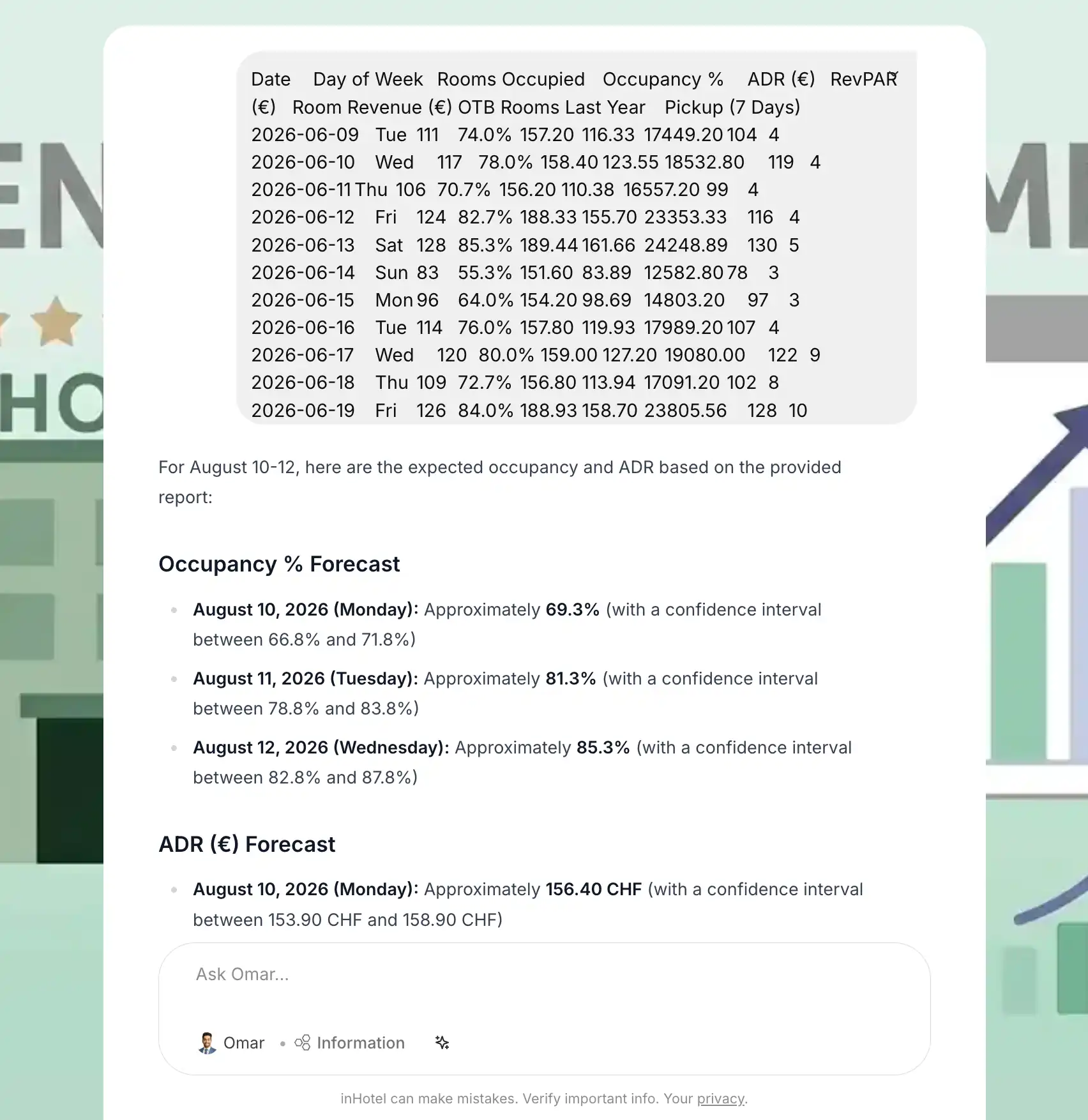
The backend execution log confirms that the assistant did not hallucinate the forecast. It called Prophet Time Series Forecasting and used the tool output, including the forecast value and confidence bounds, in its response.
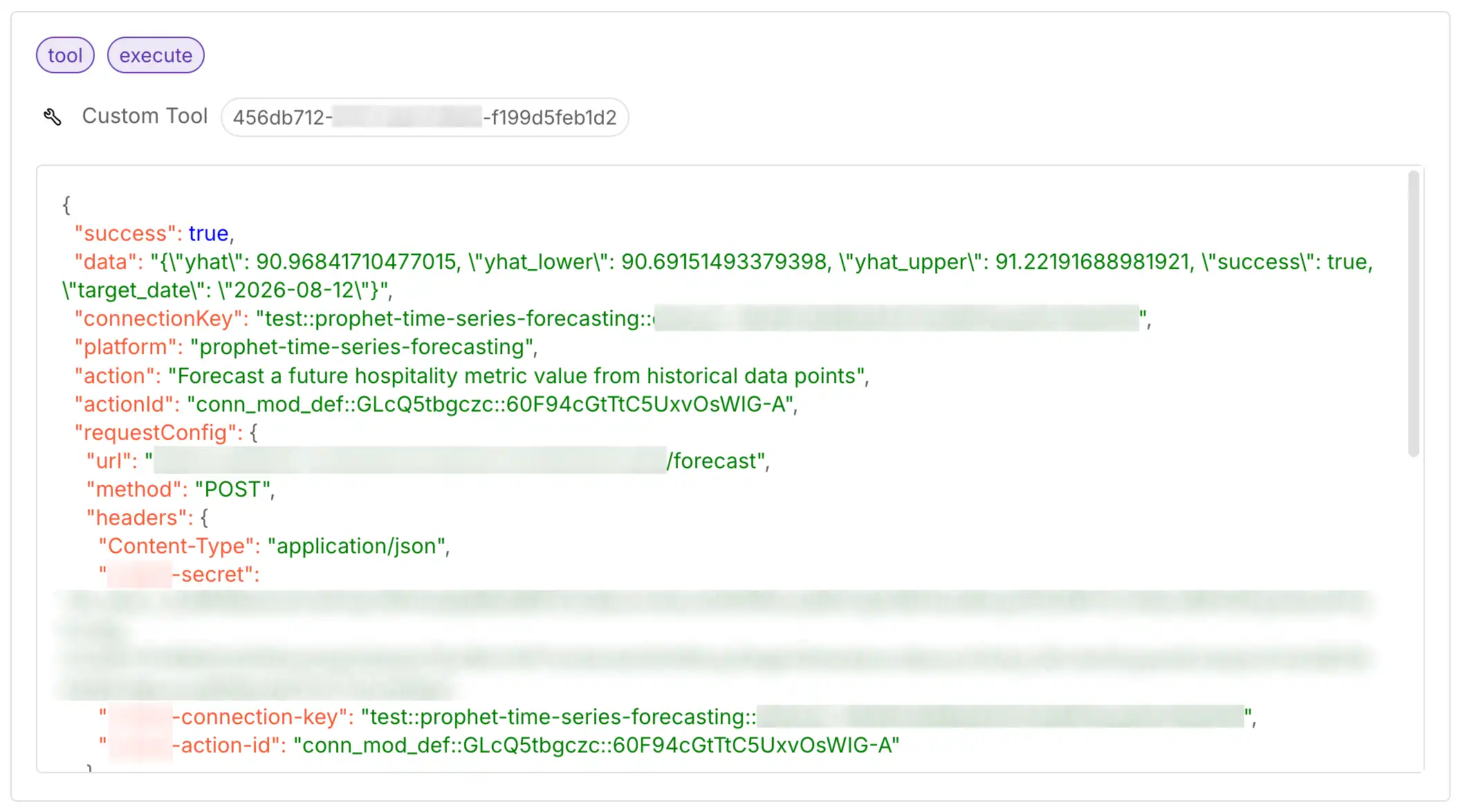
AI agents reduce hallucination risk by forecasting with tools and real data.
Open-Source Forecasting Inside Hotel Workflows
One of the ideas behind inHotel is that powerful software capabilities should be available to hotels beyond the largest groups. Open source is a major part of that belief.
Prophet is open source. It was developed by data scientists at Facebook and made available to the wider community. By bringing it into AI Hotel as an agentic tool, we are making that forecasting capability available to hotel assistants in a practical hospitality context, at no additional cost to users.
This is especially important for independent hotels and smaller groups whose main data system is the PMS. Many useful forecasting questions start with data the hotel already has: occupancy by date, Business on the Books, pickup, room revenue, ADR, arrivals, departures, breakfast covers, or other date-based metrics.
Specialized RMS and BI tools still matter for hotels that need advanced pricing optimization, competitor data, enterprise reporting, inventory controls, and deep commercial automation. Prophet Time Series Forecasting gives PMS-based hotels a practical forecasting layer for directional decisions before those larger investments make sense.
Our commitment is simple: when proven open-source technology can solve a real hotel problem, we want to make it usable for hoteliers. That means selecting the right project, connecting it to hotel data, wrapping it in safe agent workflows, and translating the output into decisions a hotel team can act on.
This model puts forecasting inside the conversation where the work starts.
Hoteliers should not pay enterprise prices for capabilities open source already provides. inHotel turns proven, free technologies into AI agent tools.
The same principle applies across other inHotel capabilities. Our AI Agent API Tool Connector connects assistants to live systems. Our AI agent skills for hotel operations turn specialist workflows into reusable skills. Prophet Time Series Forecasting adds quantitative forecasting to that agentic toolkit.
Forecasting Limits and Data Quality Rules
Every forecast depends on the data and assumptions behind it. That matters especially in hotels, where historical PMS data may reflect only the demand the hotel sold.
Hotels should keep these limits in mind:
- Historical data quality matters. Missing dates, changed reporting definitions, and inconsistent segmentation can weaken the forecast.
- Constrained demand can mislead the model. If a hotel was sold out or restricted, PMS data may show capacity while true market demand was higher.
- Events need context. Prophet can model regular seasonality and holiday effects. Unusual one-off events should be provided as business context.
- Forecasts should be updated. As pickup changes, forecast quality improves when agents can refresh the data.
- Human judgment remains essential. A forecast is one input to a decision.
The best use of Prophet Time Series Forecasting is better decision support: faster, more consistent, and more transparent than manual guessing.
Prophet Forecasting Is Available for Hotels Now
Prophet Time Series Forecasting is now available as an inHotel agentic tool. It can be used by hotel assistants to forecast future values from historical time series data, including occupancy, demand, revenue, costs, staffing-sensitive volumes, F&B demand, and other hotel metrics.
We are starting with group sales and group displacement because the business case is immediate. The same tool can support a much wider set of forecasting questions wherever hotel teams have reliable historical data.
Hotels need assistants that can reason with the numbers already sitting in their systems.
How to Activate Prophet Forecasting in inHotel
Hotels can activate Prophet Time Series Forecasting from the customer portal in a few minutes.
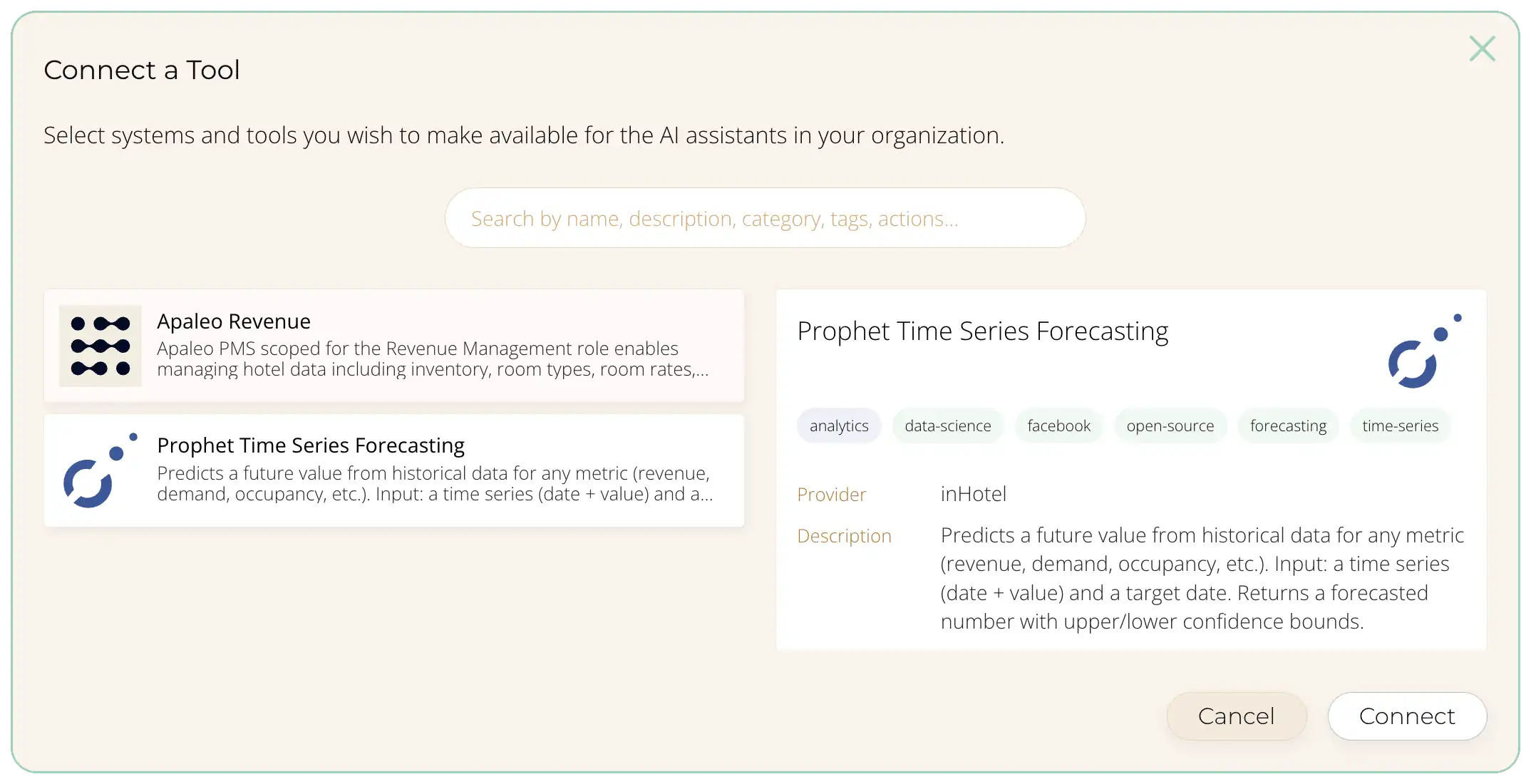
- Open the customer portal and choose the assistant. Select the hotel AI assistant you want to equip with forecasting knowledge.
- Go to Tools and find Prophet Time Series Forecasting. Open the tool, hit Learn, and the assistant will learn how to use Prophet forecasting.
- Give the assistant a forecasting task. Paste a PMS, POS, or finance report with dates and values, then ask the assistant to predict how the values may evolve and estimate a specific value on a future date. If the assistant already has access to PMS, POS, or other live systems through the AI Agent API Tool Connector, simply ask the question and let the assistant retrieve the data it needs.
Try a direct prompt such as: "Forecast occupancy for the next 30 days from this PMS report and estimate occupancy for July 15 with confidence bounds." Then watch your assistant use its new forecasting capability in the flow of real hotel work.
Frequently Asked Questions
What is Prophet Time Series Forecasting for hotels?
Prophet Time Series Forecasting is an agentic hospitality tool that predicts a future value from historical date-and-value data. A hotel assistant provides a time series and a target date, such as occupancy by stay date for a future group request. The forecast returns an expected value plus lower and upper confidence bounds so the assistant can explain both the likely outcome and the uncertainty around it.
Which hotel metrics can Prophet forecasting predict?
Prophet forecasting can predict hotel metrics that can be represented as date-and-value time series. Common examples include occupancy, demand, room revenue, ADR, costs, staffing volumes, breakfast covers, banquet demand, food waste, and other operational measures. Forecast quality depends on the consistency of the history, the amount of relevant seasonal data, and whether the metric has a clear business meaning.
Is there a free alternative to hotel RMS tools?
Prophet time-series forecasting can act as a free alternative for hotels that need directional forecasts rather than a full revenue management system. It helps AI agents estimate occupancy, demand, revenue, staffing, or F&B volumes from date-and-value data. Full RMS platforms usually add pricing optimization, inventory controls, competitor rate data, business rules, and deep integrations. Prophet is best for practical forecasting workflows across departments.
Why does Prophet forecasting return confidence bounds?
Prophet forecasting returns confidence bounds because hotel forecasts are estimates with uncertainty. A range helps teams evaluate downside and upside risk around the expected value. For example, an occupancy forecast with a high upper bound may indicate displacement risk for a group booking, while a low lower bound may support more conservative staffing, purchasing, or F&B preparation.
How does Prophet forecasting support hotel group sales?
Prophet forecasting supports hotel group sales by estimating future occupancy and transient demand for the dates requested by a group. A hotel assistant can compare the forecast with the proposed group value and flag possible displacement risk. The commercial decision should still consider group rate, wash, F&B contribution, meeting space revenue, contract terms, and local market context.
Can hotels use Prophet forecasting with only a PMS?
Hotels can use Prophet forecasting with only PMS data when the PMS contains reliable historical date-and-value information, such as occupancy, Business on the Books, pickup, arrivals, departures, ADR, or room revenue. Open-source Prophet is a viable and flexible forecasting solution for many hotel questions, especially when an AI assistant can interact directly with the PMS, POS, finance system, or other connected data sources. Specialized RMS or BI tools remain useful for advanced pricing optimization and competitor intelligence.
How can hotels reduce the risk of AI hallucinating a forecast?
Hotels can reduce the risk of AI hallucinating a forecast by giving AI assistants access to forecasting tools that use real PMS, POS, or financial data instead of relying only on generated text. Prophet Time Series Forecasting lets an inHotel assistant call a dedicated forecasting tool, return a forecast value with confidence bounds, and give inHotel a backend execution trail to verify that the forecast came from the tool.