inHotel and OpenTravel at apidays - Paris, 2025
A fast look at how hotels, industry experts, and travel platforms can scale expertise, reduce cost, and collaborate through grounded and aligned AI agents.



Overview
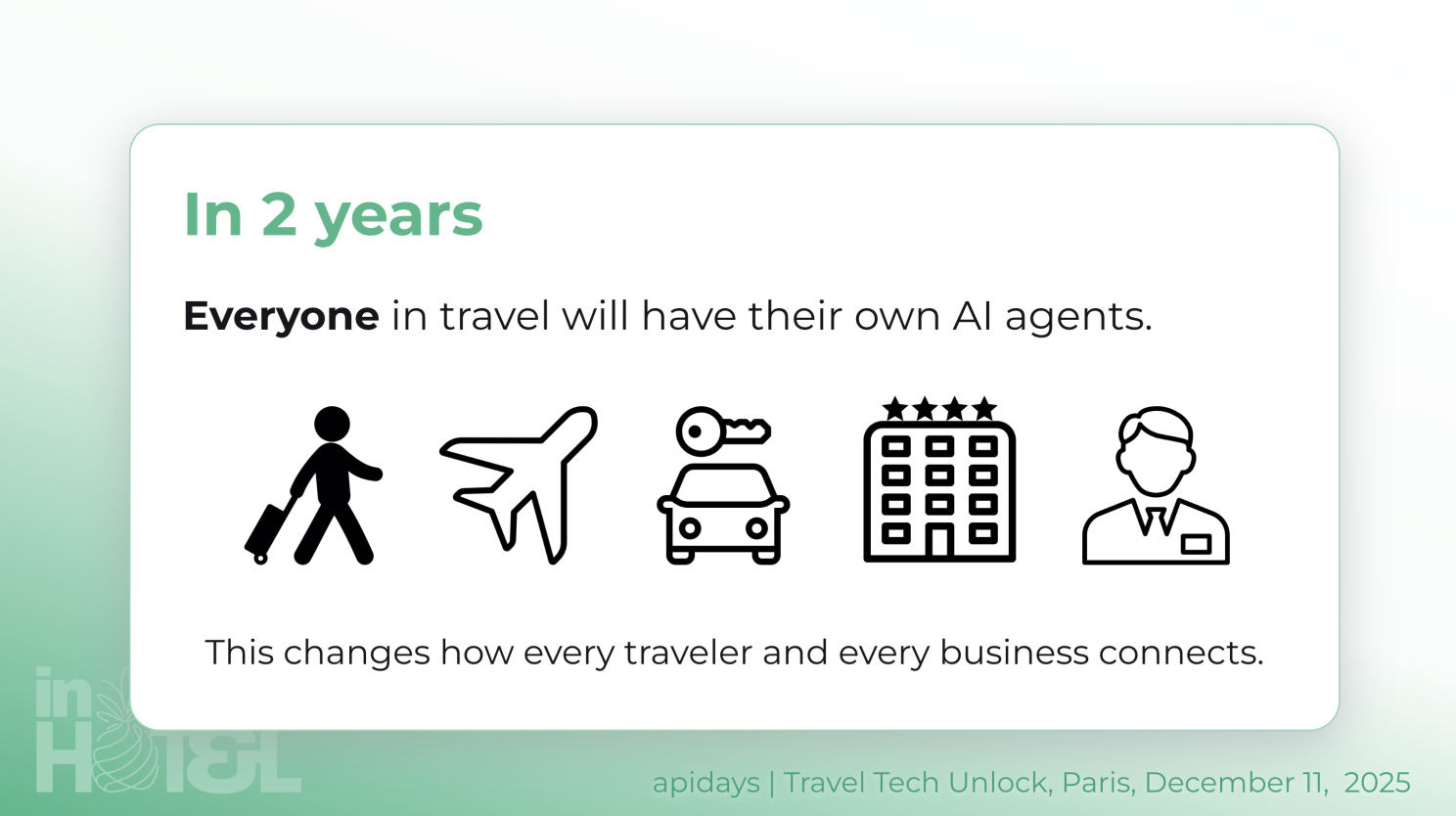
At apidays Paris (Travel Tech API Conference), we (through Jan) unveiled how travel and hospitality are shifting from fragmented, high-cost integrations to an open, agent powered ecosystem. The session introduced a future where every traveler and every business operates through AI agents that collaborate, coordinate information, and improve decisions across the entire value chain.
Key points from the presentation
1. Agents as teammates for hotels: Hotels can deploy role-based agents for reservations, revenue, operations, and guest experience. These agents support understaffed teams, provide consistent expertise, and work with human staff to improve outcomes with less effort. We encouraged industry experts to create their own digital twins (AI personas) so they can represent themselves in the emerging agentic economy, and demonstrated how these expert agents can participate in virtual team meetings to support decision-making. (Thank you Victoria Meyers and Radka Telyckova for contributing your expert insights to this Q1 planning session with your twins!)
2. Improving distribution with A2A and GERS: Travelers often visit more than 40 pages before booking and hotels spend 10-35% of revenue to acquire a guest. We presented how A2A combined with GERS makes hotels directly discoverable across maps, AI search, DMOs, travel agencies, and partner sites. Guests can contact the right hotel agent instantly using the free, contextual Focus Chat website chat plugin, which adapts to the page the traveler is on.
3. Connected destinations: By grounding every hotel and local business in Overture Maps Foundation GERS IDs, agents can understand their surroundings and collaborate. Enterprises and travel tech companies can use the GERS API to give their AI agents the ability to perform nearby searches—discovering not only places but also the agents "working" there. This allows accommodation providers, restaurants, tour operators, transportation companies, and other neighborhood businesses to link their digital presence and create a seamless local discovery experience.
4. Integrations that take hours instead of months: Agents can read API specs, admin and user documentation, and SOPs. This allows them to support technical and operational teams and dramatically shorten integration timelines. MCP and well documented APIs make this possible at scale. (Jan: I skipped this demo in the interest of time, please feel free to contact me offline if this is of interest to you.)
5. A practical first step for hotels: We encouraged hoteliers to begin with their agentic commercial team. Reservations and Revenue agents help reduce distribution cost and increase owner value while engaging guests across websites, maps, AI search, DMOs, travel agencies, and corporate channels.
6. Why this future requires OpenTravel: Open ecosystems only succeed when the industry shares data models and standards. The OpenTravel Alliance enables companies to pool engineering and governance and influence how agent interoperability and the next generation of travel schemas are shaped. Joining now also secures current membership fees before the upcoming Foundation structure increases them.
Explore the slides
The full deck includes visuals, examples, and links to publicly available demos that show how A2A, APIs, and open standards reshape travel. We invite you to explore it and see how your organization can benefit from this new architecture for speed, lower cost, and stronger performance.
Thank you!
A huge thank you to all participants for the energy in the room. The virtual team meeting demo and the agent grounding in maps sparked thoughtful and provocative questions from every corner of the audience. The crowd was amazing, deeply engaged, and genuinely curious about how this next chapter of travel will unfold.
I left inspired by your enthusiasm and excited to continue the conversations.
Frequently Asked Questions
How can AI agents be used in hotel operations through APIs?
AI agents can be connected to hotel systems through APIs to act as operational co-pilots for reservations, revenue, and guest experience. In practice, inHotel provides role-based agents that integrate with PMS, RMS, booking engines, and internal knowledge. These agents can answer questions, apply business rules, and support daily decision-making while remaining aligned with hotel policies and SOPs. For API teams, this means exposing well-documented endpoints that agents can safely call, rather than building rigid workflows. The result is faster execution and less manual effort across hotel operations.
What is Agent-to-Agent (A2A) communication in travel technology?
Agent-to-Agent communication allows AI agents representing different businesses to talk directly to each other instead of routing everything through centralized platforms. In travel, inHotel uses A2A so hotel agents can interact with traveler agents, destination platforms, or partner agents in real time. This reduces friction, improves response quality, and enables direct engagement without heavy custom integrations. From an API perspective, A2A relies on shared protocols, identifiers, and permissions rather than bespoke point-to-point connections.
How can AI agents improve hotel distribution?
AI agents can represent hotels directly across maps, AI search, DMOs, and partner websites, allowing guests to contact the right hotel agent instantly. inHotel enables this by combining A2A with contextual chat interfaces and direct access to authoritative systems like PMS and booking engines. Instead of pushing static ARI data, hotels expose conversational access to availability, policies, and offers. This approach reduces dependency on intermediaries and lowers acquisition costs while preserving guest data ownership.
What problem do global place IDs solve in travel APIs?
Global place IDs solve the issue of fragmented and inconsistent location data across systems. Using GERS, a global geospatial identifier standard, inHotel grounds hotels and local businesses to a single canonical place reference. This allows AI agents to reliably understand where a business is located and what is nearby. For API teams, this simplifies joins, improves accuracy, and enables location-aware features like nearby discovery, referrals, and contextual recommendations.
How can AI agents perform nearby searches in travel applications?
AI agents can perform nearby searches by querying a geospatial API that returns places and services around a known location. inHotel uses the GERS API to give agents the ability to discover nearby hotels, restaurants, transportation, and attractions. This allows agents to answer questions like what is near the hotel or which partner is closest. For travel tech companies, this unlocks richer discovery experiences without building custom mapping logic.
Can AI agents really reduce integration timelines for travel APIs?
Yes. AI agents can dramatically reduce integration timelines by reading API specs, admin documentation, user guides, and SOPs together. inHotel demonstrates how agents bridge the gap between technical APIs and operational workflows by reasoning through integration steps like a human would. When agents participate in onboarding or integration tasks, teams can move from weeks or months to days or hours, especially when APIs are well documented and consistent.
What makes an API agent-friendly in hospitality?
An agent-friendly API is predictable, well documented, and aligned with real business actions. Clear schemas, descriptive endpoints, example payloads, and good admin and user documentation are critical. inHotel shows that when agents can combine API specs with SOPs and business rules, they can safely execute tasks on behalf of users. This shifts API design from pure machine-to-machine thinking to human-plus-agent collaboration.
How do AI personas or digital twins fit into travel platforms?
AI personas are agent representations of human experts, such as consultants or industry specialists. inHotel encourages experts to train digital twins on their insights so those agents can participate in virtual meetings or support hotel teams continuously. From a platform perspective, this allows expertise to scale without requiring constant human availability, while still remaining grounded in real experience and accountability.
Why do open standards matter for AI and APIs in travel?
Open standards reduce risk, cost, and fragmentation when building AI-driven travel systems. The OpenTravel Alliance (https://opentravel.org) provides a neutral space where companies can align on data models, schemas, and interoperability. inHotel builds on these standards to ensure its agents can operate across ecosystems rather than being locked into proprietary silos. For API leaders, this means faster adoption, lower integration overhead, and a future-proof architecture.