From SaaS Apocalypse to Investing in Hotel Agent Skills
Hospitality investors and operators can replace SaaS by building, owning, and monetizing AI Agent Skills on open standards compatible with Anthropic Claude.


AI Agent Skills Disrupt Industries and Hotel Tech Is Next
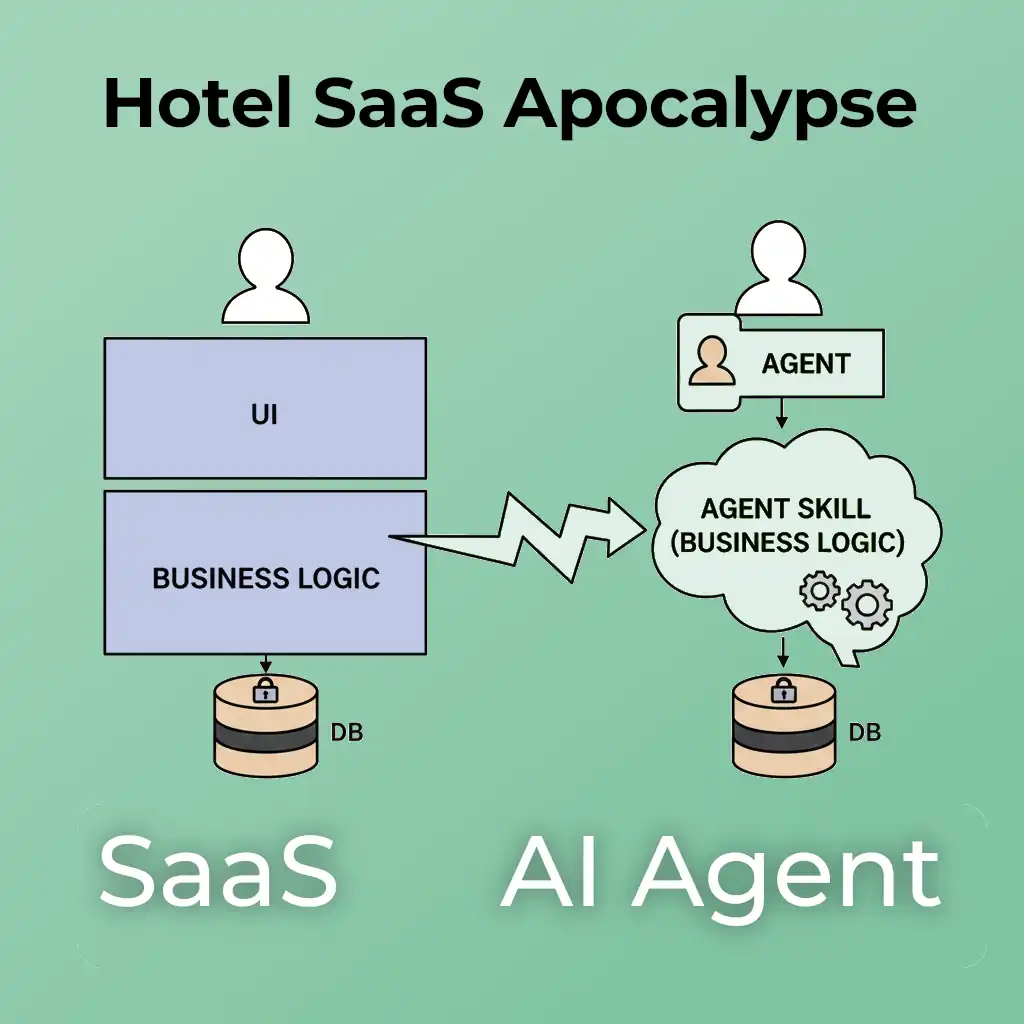
When agentic AI Skills entered the mainstream, hundreds of billions in software market value disappeared within days. Investors recognized something uncomfortable: a surprising amount of “software value” is really human workflow wrapped in a subscription. When AI agents can execute that workflow directly, the subscription layer itself gets squeezed.
Legal tech, finance platforms, CRM systems, and workflow tools were all repriced.
Hospitality has historically moved slower and operated inside a fragmented ecosystem. Thousands of independent operators, legacy systems, and uneven integrations slowed large-scale disruption.
But fragmentation does not eliminate structural exposure.
Look closely at hotel tech stacks.
Guest responses. Checklists. Task management tools. Dashboards. Reporting layers. “AI add-ons.” Integrations that still depend on humans to click, copy, paste, reconcile, approve, and chase.
If agents collapse workflow-driven SaaS categories elsewhere, and hospitality suffers from chronic staffing shortages, hotel SaaS sits directly in the blast radius because much of its daily value depends on repetitive coordination work.
Agents overcome fragmentation by sitting above existing systems. They pull data, call tools, execute actions, and coordinate across PMS, RMS, CRM, spreadsheets, and inboxes without forcing full replacement.
That shift reframes the investor question.
If workflows are becoming the new execution layer across departments, how do you gain exposure to that layer without guessing which AI startup wins?
Invest in Hospitality AI Agent Skills
One approach is to invest directly at the workflow level.
An inHotel Skill is not “AI in general.” It is the thing your best operator does repeatedly, encoded into structured logic and turned into an asset that runs alongside your team. It captures SOP steps, decision rules, context, and economic thresholds so an agent can execute consistently.
Instead of backing a broad technology platform, you fund a specific operational capability you already understand.
Examples include:
- Housekeeping and F&B staff roster scheduling based on room occupancy and weather forecasts
- Automatic generation of high-performing FAQs for your website so your property ranks in SEO and AI-driven search
- Creation of tailored responses to event RFPs that align with brand positioning and availability
- Estimating the financial consequences of multiple property renovation scenarios before capital is deployed
Each of these is a repeatable, high-impact workflow that can be encoded, owned, and distributed.
From an investment standpoint, a Skill has narrow scope, clear operational defensibility grounded in domain expertise, short feedback loops inside real properties, and explicit asset ownership, including code, prompts, workflows, knowledge bases, and documentation that you control and can deploy on inHotel or elsewhere.
You are investing in defined economic behavior rather than a product roadmap.
Anthropic Compatible Open AI Agent Skills for Hospitality
The Skills that triggered the SaaS Apocalypse were built on an open Agent Skills standard. inHotel uses that same open format. Skills can be imported and exported in full compatibility with Anthropic's Claude. This ensures portability and avoids proprietary lock-in.
On top of the open schema, inHotel adds hospitality-specific depth:
- Industry knowledge base
- Agent-to-agent workflows
- Multi-model support (avoiding dependency on Anthropic, if you prefer ChatGPT or Gemini)
- Low-tech usability for operators
Tailoring AI Agent Skills for Hotel Operations
The difference between a generic AI demo and a production Skill is operational tailoring.
That includes prompt adjustments such as terminology, tone, compliance rules, and brand standards. It includes workflow adjustments such as approval logic, escalation paths, and cross-department coordination. It also relies on property-level variables that reflect market positioning, risk tolerance, staffing models, and owner priorities.
If you have internal capability, you can self-build. If not, you can co-build with inHotel through structured, milestone-based funding tied to scope and validation. Ownership remains with the funder.
This is how operational know-how becomes a distributable asset.
Hotel AI Agent Skills Investment Case Study
To make this concrete, consider Revenue Management.
Assume you invest €15,000 to build a Skill focused on Group Displacement Analysis.
An agent equipped with this Skill, such as our Revenue Assistant, automatically:
- Pulls forecast and on-the-books data
- Evaluates group requests against transient demand
- Calculates displacement costs
- Recommends accept-or-reject decisions with structured justification
You price it at €100 per month, backed by a demonstrated value creation of at least €1,000 per property per month through better acceptance decisions and margin protection.
You point your professional network to it, and inHotel also promotes your Skill and helps you reach 50 customers through its hospitality marketplace and distribution infrastructure.
Gross subscription revenue:
50 × €100 = €5,000 per month
Platform hosting and support costs:
50 × €20 = €1,000 per month
Remaining:
€5,000 − €1,000 = €4,000
Skill owner share at 80%:
€4,000 × 0.80 = €3,200 per month
Payback on €15,000 occurs in under 5 months.
The economics are grounded in a single workflow that materially impacts margin.
Managing Risk in Hospitality AI Investments
Hospitality tech investments usually fail for two reasons: unclear value or slow adoption. The Skill model reduces both.
inHotel only distributes Skills that demonstrate a target 10× ROI for hoteliers. At a €100 subscription price, the Skill must create at least €1,000 in measurable monthly value before scaling.
If you are an active hotelier solving your own operational challenge, the internal benefit anchors the investment. Because the Skill is required to deliver at least €1,000 per month in value, your own property captures that economic impact immediately. Even without external sales, the operational improvement offsets a meaningful portion of risk. External adoption then compounds upside rather than carrying the full burden.
The exposure is tied to operational economics you already understand.
AI Agent Skills Adoption Across Hotel Departments
As Agent Skills are moving beyond demos and into real hospitality workflows across departments, you have three options:
a) Adopt existing Skills and save hours each week
b) Build and turn proven workflows into revenue-generating assets
c) Continue running manual processes, spreadsheets, copy-paste tasks, and reactive coordination
Operators who convert their professional know-how into distributable, monetizable Skills position themselves on the execution layer that is replacing yesterday’s SaaS.
First-Mover Advantage in Hospitality AI Agent Skills
Once workflows become the primary execution layer, ownership compounds.
Early movers gain faster learning loops from validating real workflows inside operations. Successful Skills generate distribution compounding as marketplace exposure scales adoption. Over time, the most credible “golden SOP” Skills become category references that others adopt.
Hospitality is entering the same structural transition already visible in other industries. The upside will be captured by someone.
It might be you.
Explore the opportunity in more detail and book a call with our team (or chat with our Solutions Specialist AI agent) to pressure-test your workflow and assess whether it is a strong candidate for a Skill.
Frequently Asked Questions
How will AI Agent Skills disrupt SaaS hotel technologies?
AI Agent Skills disrupt traditional hotel SaaS platforms by replacing manual, dashboard-driven work with automated workflow execution. Much of hotel software still depends on staff to coordinate work by copying data between systems, reconciling reports, approving tasks, and chasing follow-ups. Agent Skills sit above the hotel technology stack, pull data from PMS, RMS, CRM, and spreadsheets, apply predefined SOP logic, and produce decisions or actions. This reduces reliance on multiple subscriptions that mainly organize human work instead of performing it. In other industries, agentic automation has already triggered major repricing of workflow-driven software because the subscription layer becomes less defensible once execution is automated. Hospitality is exposed because daily operations remain coordination-heavy and staff constrained.
How can hoteliers invest in AI without betting on the wrong startup?
A practical way to invest in hospitality AI is to invest at the workflow level rather than betting on a broad AI startup. That means funding a specific AI Agent Skill tied to a well-understood operational problem such as staffing optimization, RFP response automation, guest communications, or financial scenario modeling. Because the scope is narrow and grounded in existing SOPs, the risk is easier to evaluate than a platform bet. You can validate the Skill inside your own operation, measure the KPI impact, and decide whether it deserves wider rollout. This approach shifts AI investment away from speculative technology narratives and toward operational economics you already understand and can control.
Are AI Agent Skills compatible with Anthropic Claude and open standards?
Yes. Agent Skills can be built to be compatible with Anthropic’s Claude AI and the Open Agent Skills standard. Using an open standard allows workflows to be imported, exported, and reused across platforms, which reduces vendor lock-in and improves portability. It also makes it easier to switch between models such as Claude, ChatGPT, or Gemini without rewriting the core workflow logic. For hospitality investors, open compatibility protects the underlying asset, meaning the workflow design and execution structure can remain stable even as model providers and tooling evolve. An authoritative reference point for the open standard is https://agentskills.io.
How can hotel AI tech investors reduce the risk of SaaS disruption?
Investors can reduce SaaS disruption risk by prioritizing workflow-level AI investments with measurable outcomes rather than relying on broad software platforms. The most common failure points in hospitality technology are unclear value and slow adoption. AI Agent Skills mitigate both by targeting narrow, high-impact processes and validating them inside existing operations before wider deployment. Internal validation anchors returns to tangible performance metrics such as labor hours saved, response time reduced, or margin protected. If the workflow performs within your own portfolio, the downside is largely limited to controlled operational experimentation rather than market speculation. This approach builds resilience even as traditional SaaS vendors face pricing pressure from agentic automation.
Why is there a first-mover advantage in hospitality AI Agent Skills?
First movers benefit because workflow ownership can become a durable advantage when agents become the primary execution layer. Early adopters learn faster by validating Skills in live operations, improving workflows based on real constraints and data. Successful Skills can then scale across a portfolio, while distribution channels amplify adoption. In emerging AI categories, the first validated workflow often becomes the industry reference model that later entrants follow. Over time, the most credible “golden SOP” Skills become category standards that others adopt, which reinforces the position of the creators and owners. Hospitality may move slower, but once adoption accelerates, reference workflows tend to win.
What is the best AI investment strategy for hotels?
The best AI investment strategy for hotels is to focus on high-impact operational workflows rather than broad, speculative technology platforms. Instead of adding another SaaS subscription, hotels can invest in AI Agent Skills tied to measurable problems such as revenue decisions, staffing efficiency, proposal automation, guest communications, or financial modeling. The key is selecting workflows with clear economic impact and validating ROI internally before scaling. Once proven, the same Skill can be deployed across multiple properties or monetized externally. By investing at the workflow level, hotels align AI adoption with cost control, margin protection, and long-term ownership of how work gets done.
What is vertical AI for hospitality and why is it different from generic SaaS AI?
Vertical AI for hospitality is AI built specifically around hotel operational workflows, KPIs, and data structures rather than generic cross-industry automation tools. Generic SaaS AI often adds features to dashboards and still relies on staff to execute processes manually. Vertical AI encodes hospitality-specific SOPs, for example staffing optimization, RFP response logic, displacement analysis, and renovation scenario modeling, and enables agents to execute these workflows directly. This matters because hotels have unique service standards, operational rhythms, and metrics that generic tools do not capture well. For investors and operators, vertical AI reduces implementation friction, accelerates ROI, and turns AI into an operational asset rather than another subscription layer.
Will AI Agent Skills replace traditional hotel SaaS?
AI Agent Skills are likely to replace parts of traditional hotel SaaS, especially tools whose main function is organizing manual workflow rather than providing system-of-record capabilities. Many SaaS products in hospitality still rely on staff to move data, reconcile reports, approve tasks, and follow up across systems. Agent Skills can execute those workflows directly by pulling data from PMS, RMS, CRM, and spreadsheets, applying SOP logic, and producing actions or structured outputs. In practice, many hotels will keep core systems of record but reduce the number of add-on dashboards and coordination tools as agentic execution matures. The change is gradual, with the biggest impact in repeatable, coordination-heavy processes where staffing constraints make automation economically compelling.