How AI Agent Skills Improve Hotel SOPs and Operations
Create effective hotel SOPs, avoid common mistakes, and improve operations using an AI agent skill that enhances consistency, accountability, and execution.


Overview
Hotel SOPs are essential for maintaining consistent service quality and guest satisfaction across every department. However, many hoteliers struggle with writing procedures that actually work.
While many look for a quick fix, most online hotel SOP templates are generally very poor quality and fail to address the complexities of daily operations. There is a better way to build, audit, and refine your processes using AI agent skills.
What is a hotel SOP?
A Hotel Standard Operating Procedure (SOP) is a documented, step by step set of instructions designed to help staff carry out complex routine operations. The primary goal of a hotel SOP is to achieve efficiency, quality output, and uniformity of performance while reducing miscommunication and failure to comply with brand standards and industry regulations.
In a modern hotel environment, an effective SOP acts as the "source of truth" for everything from front desk check-in protocols and housekeeping cleaning standards to emergency response and guest recovery workflows. Unlike a simple checklist, a high-quality SOP defines:
- Who is accountable for each action (RACI).
- When the action must take place.
- How to handle exceptions or guest complaints.
- What success looks like for that specific task and workflow.
The Reality of Hotel Operations
Most operational problems begin in a document.
A procedure gets written. It looks polished. It gets approved. Everyone nods. Then Monday morning arrives. Housekeeping interprets one step differently. Front Office assumes someone else owns the guest follow-up. Maintenance never receives the handover. By lunch, a simple process has turned into three calls, one complaint, and a manager fixing preventable mistakes.
That is why we built the SOP Quality Assessment skill, a next-generation solution for standard operating procedures in hotels, now available in the inHotel Skills Marketplace.
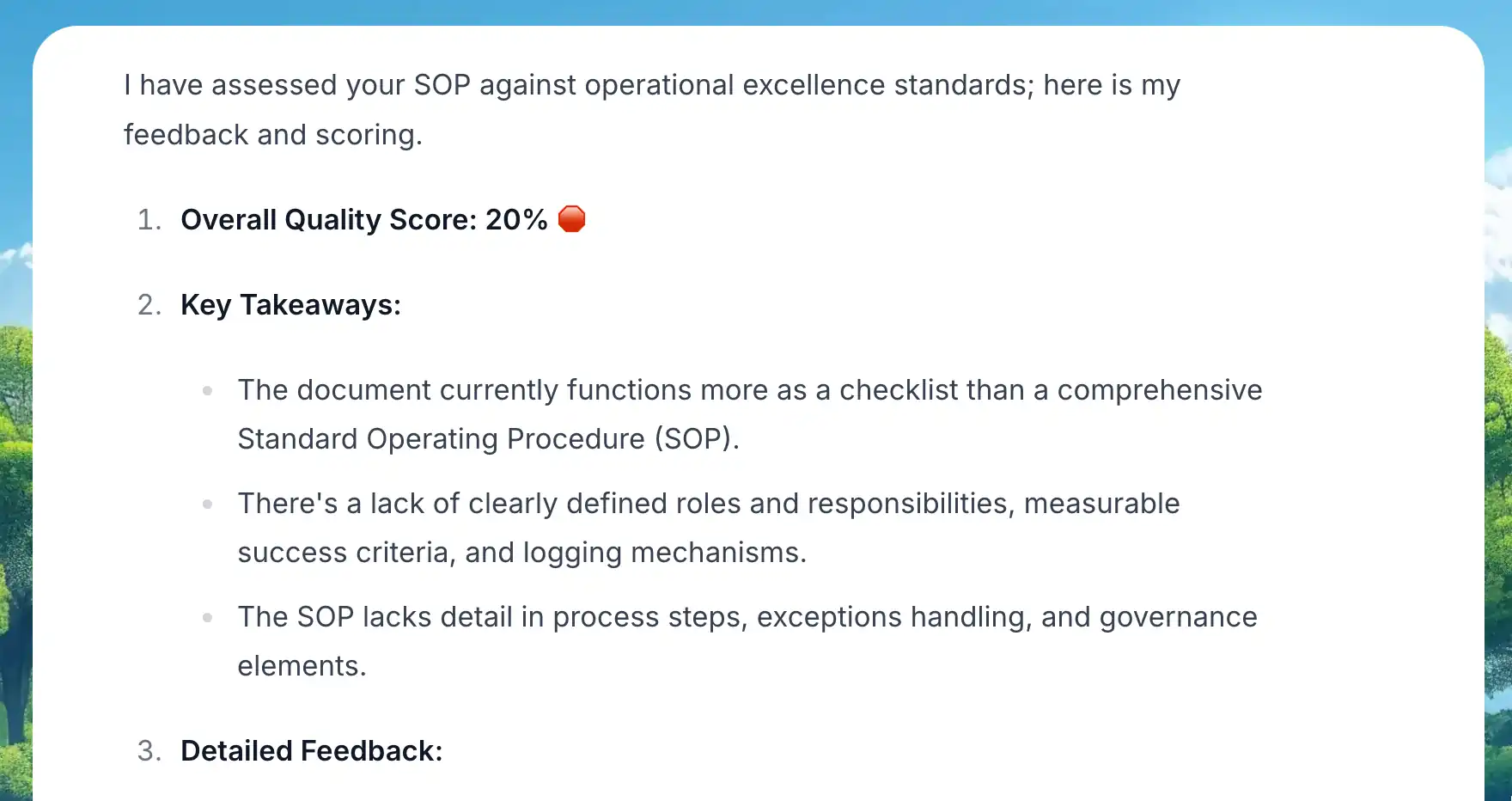
This AI for hotel operations helps teams evaluate procedures before they fail in real life. It scores process quality, identifies accountability gaps, flags risk areas, and highlights consistency issues that quietly create friction across shifts, departments, and properties.
Common hotel SOP mistakes that cause operational failures
Most SOPs are judged by how they read. They should be judged by how they perform. The real test of hospitality management is not whether a procedure sounds professional in a boardroom. It is whether a tired night auditor can follow it at 2:15 a.m. without guessing. It is whether a new room attendant can execute it correctly on day three.
Why you should avoid generic hotel SOP templates
When looking to document processes, many hoteliers search for free hotel SOP templates. While these seem like a quick fix, they are often a trap for two reasons:
- Templates are typically poor quality: Most online templates are generic checklists, not functional processes. We evaluated over 50 top hits using our assessment framework; the vast majority scored in the range of 20% to 40% for operational readiness.
- They don't reflect your reality: If an SOP doesn't match how your team actually works, they won't use it. The result is a "dusty manual" and a wasted effort.
SOP templates don't save time; they import someone else's problems.
Best practices for creating hotel processes
- Interview the experts: Talk to the people doing the work today. Capture how they do it in simple, plain language.
- Audit with AI: Run those captured notes through the SOP Quality Assessment skill. It will help you identify improvement opportunities and fill procedural gaps that a generic template would miss.
Most online SOP templates confuse checklists with processes
A common mistake in hospitality is confusing a checklist with a process. A checklist tells you what needs to happen; a process ensures it actually happens consistently. Consider this typical example often found in traditional manuals (source: Siteminder):
Standard procedure for servicing of occupied rooms:
1. All occupied rooms are serviced twice daily and as and when requested by the guest.
2. Enter the room according to the procedure of entry to guestrooms.
3. Clear the garbage according to the procedure of removal of garbage from dustbins.
4. Collect any dirty linen.
5. Make the bed, follow the bed making procedure.
6. Perform dusting of the room.
7. Vacuum carpet and undertake upholstery maintenance.
8. Clean bathroom.
9. Replenish all amenities in the bathroom. (Maintain photograph for standard amenity placement)
10. After servicing the room, check the function of all features such as the TV, telephone, lights etc.
Why this fails the quality test:
This is just a list of tasks, a checklist, not a process. It lacks specific timing, clear ownership for exceptions, and success criteria. Does "Collect dirty linen" include a count? What happens if the guest has left personal items on the bed? Without addressing these "hidden assumptions," this document ensures that different staff members will execute the task in different ways, leading to inevitable service fallouts.
Hospitality expertise meets process excellence
Before founding inHotel, I (Jan) was responsible for developing operational processes in the corporate offices of Hilton and Kempinski. Later, at Google, I represented the Android organization in a company-wide process excellence workgroup focused on best practices for large-scale operations. I led a two-year process improvement program that doubled the ROI of the operational group to 4.5x, recovered total workload equivalent to dozens of fulltime engineers, and reduced human delivery errors by three orders of magnitude to a consistent >96% SLO.
The lessons from both worlds were clear:
- Well defined processes create predictable, seamless operations and breathing room for employees.
- Vague or undocumented processes create noise, friction, and constant busywork.
Hotel operations do not need to be about constant busywork.
They are what you design them to be. Messy or smooth, it depends largely on your operating procedures.
We have distilled these assessment methods into an AI-driven workflow, allowing any property to access institutional-grade operational excellence through the inHotel marketplace.
I can already hear the objection: "Documenting processes is overkill. We do not need those."
Well, undefined processes are a liability. In an industry with high turnover, an "undefined" procedure usually means the operation is either messy in the short term or at extreme risk in the long term. If your standards live only in the heads of a few key employees, your consistency disappears the moment they walk out the door. High attrition should not mean a drop in service quality, but without documented, high-quality processes, that fallout is inevitable, even if you patch it with constant training.
If your standards only live in the heads of key employees, your consistency leaves when they do.
How an AI agent skill improves hotel SOP quality
The SOP Quality Assessment AI agent skill reviews your procedure and gives clear, usable feedback in seconds. Unlike traditional hospitality SOP software that simply acts as a digital filing cabinet, this skill drives hospitality workflow improvement by analyzing:
- Clarity: Are instructions specific, readable, and easy to follow under pressure?
- Ownership: Does every step have a clear accountable role, including RACI responsibilities?
- Execution Flow: Is the sequence logical, practical, streamlined, and free of hidden assumptions?
- Exceptions: Does the SOP cover failures, delays, guest issues, and deviations?
- Consistency: Will different shifts execute it the same way?
- Governance: Are logging, version control, approvals, and data handling defined?
- Outcomes: Are success measures clear enough to know if the process works?
One creates confusion. The other gets done.
How to integrate AI SOP auditing into hotel workflows
Processes are critical across departments, therefore any inHotel assistant can be equipped with this skill. Sometimes a hotel manager will ask directly:
- Score this SOP and give me actionable feedback.
- Which steps lack clear ownership?
- How do I improve consistency across shifts?
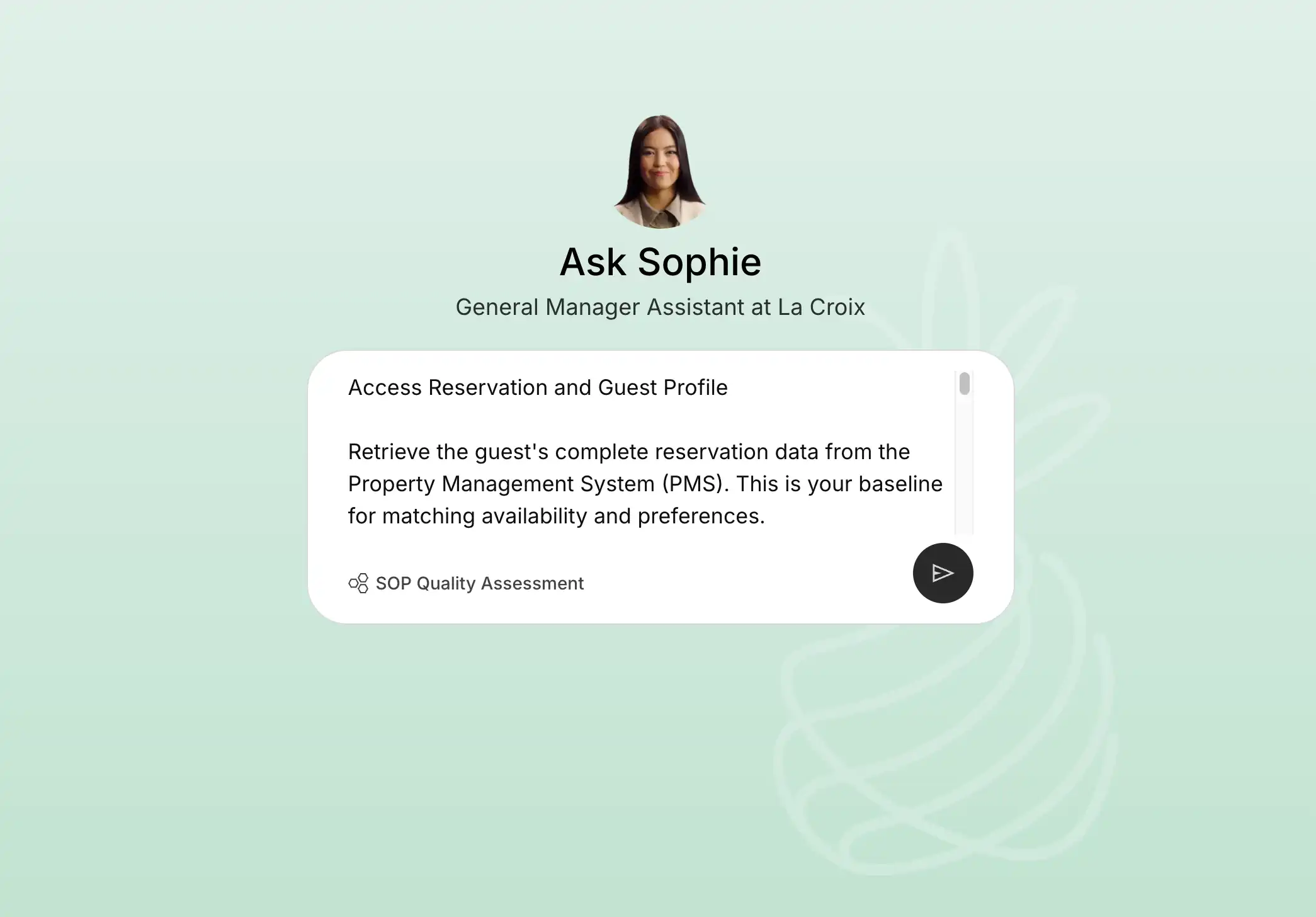
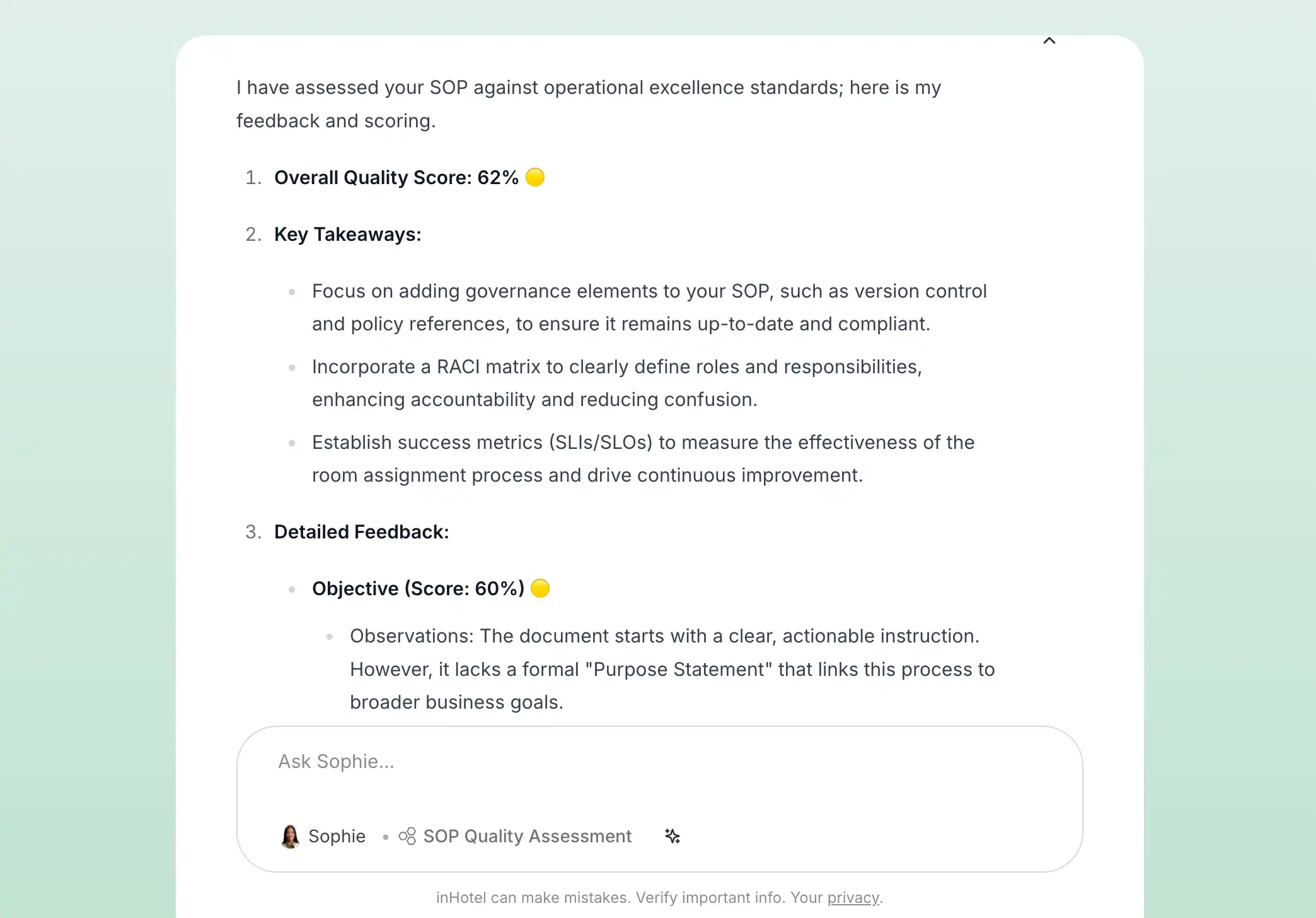
Other times, the AI assistant will recognize the moment itself. A manager asks how to reduce guest complaints tied to late room readiness. The assistant reviews the workflow, detects that process quality is the real issue, pulls the SOP Quality Assessment skill from its back pocket, and surfaces the weak links.
No extra consultant. No separate software project. Just useful help at the right moment.
Moving From Dusty Manuals to Living Documents
In the past, updating an SOP was a project everyone avoided. It was tedious, bureaucratic, and took forever. Because changing them was such a headache, people just didn't do it.
The result? A persistent gap between the "official" procedure sitting in a binder and what the team was actually doing.
AI changes the math on this. When you use an AI agent to help you manage and quality-check updates, your SOPs finally become living documents that your team can trust.
This is important for two groups in particular:
- Small, Independent Operators: You don’t need a massive corporate office to have a robust process.
- Franchisees: You can take those rigid corporate brand standards and finally adapt them to your specific building and local team without breaking the underlying logic.
When you remove the friction of making changes, the "dusty manual" dies and you end up with a tool that actually helps your staff in daily operations.
Quantifiable benefits of automated SOP quality checks
Hotels need fewer mistakes, fewer repeated questions, faster onboarding, and smoother handovers between people who are already busy.
Consistency in execution matters regardless of who is on shift, a veteran or an intern. Greater consistency drives predictable outcomes: smooth operation, less stress and fewer fallouts. This translates into guest satisfaction as they experience the results of a high-functioning operation.
Typical benefits include:
- Less time spent drafting and reviewing SOPs
- Fewer execution errors caused by vague wording
- Lower service recovery costs from preventable guest issues
- More consistent delivery across shifts and departments
- Stronger manager confidence when rolling out new processes
- High-quality process documentation ensures that your AI agents act in alignment with your human teams, preventing errors that happen when instructions are vague.
The monthly subscription costs less than a single avoidable guest recovery.
Why we built it this way
For years, process improvement expertise was locked inside large corporations or expensive consulting projects. Static hotel SOP software solved the storage problem but failed to solve the quality problem.
With agentic AI, not only chains, but any independent hotel operators can benefit from this expertise. A 100-room hotel deserves the same quality of process thinking as a global tech company. The tools may be different. The principle is identical: clear ownership, clean execution, measurable outcomes. Now that capability is available on demand.
Available now
The SOP Quality Assessment skill is live in the inHotel AI Agent Skills Marketplace.
If you want to improve hotel operations processes and stop preventable breakdowns, do not start with more meetings. Start with the procedure everyone is following. Sometimes the bottleneck is not your people. It is page two of the SOP.
Frequently Asked Questions
How can I tell if my hotel SOP will actually work before I roll it out to staff?
A tidy document proves very little. The real test is whether someone new can follow it during a busy shift without stopping to ask five questions. A strong AI SOP review tool checks for vague wording, missing ownership, broken sequencing, weak handovers, and unplanned exceptions before rollout. It shows where the procedure will wobble under pressure, so you can fix it before training starts and before guests feel the consequences.
Why do hotel SOPs fail even when the team is experienced?
Good employees often keep weak processes alive through effort alone. They remember shortcuts, fill gaps, and rescue unclear instructions from memory. That works until someone is absent, occupancy spikes, or a new hire joins the rota. Then the cracks show fast. Most SOP failures come from hidden assumptions, unclear accountability, poor timing standards, or steps buried in corporate language nobody uses on the floor.
Are free hotel SOP templates worth using?
Usually as a starting draft, not as your final operating model. Most online hotel SOP templates are generic, shallow, and detached from how your property actually runs. They may look useful, but many are little more than checklists copied from another hotel. Use them for inspiration if needed, then rebuild around your staffing levels, service promise, PMS workflow, and guest reality. A template should save time, not import someone else’s problems.
What is the difference between a hotel checklist and a real operational process?
A checklist reminds people what to do. A real standard operating procedure (SOP) makes sure it gets done properly, consistently, and on time. “Check minibar” is a checklist item. A real hotel SOP defines who owns it, when it must happen after checkout, how items are recorded in the PMS, what to do if the guest disputes charges, and what completion looks like. One jogs memory. The other runs operations.
How can AI help me write better SOPs for my hotel operations?
Avoid online templates or examples. Start with the people doing the work today. Ask them where delays happen, where confusion starts, and what gets missed. Turn those notes into a draft, then use an AI SOP Quality Assessment tool to tighten the process. It can spot unclear handovers, weak ownership, poor sequencing, and missing exception rules. That means sharper housekeeping turnaround SOPs, cleaner front desk escalations, and tighter maintenance follow-up without endless rewrites.
How do I reduce hotel staff mistakes caused by unclear procedures?
Repeated mistakes are often process failures dressed up as people issues. If minibar charges are missed, room status is wrong, or requests disappear between shifts, inspect the SOP first. AI can audit hotel procedures and flag vague wording, missing success standards, and tasks nobody clearly owns. Sometimes one unclear sentence creates months of friction. Fix the process, and many “training issues” quietly disappear with it.
Can AI improve consistency across different hotel shifts?
Yes, because inconsistency usually starts with interpretation. The morning team follows one version, evenings trim a step, weekends improvise, and after a few months nobody is using the same process. AI helps by tightening language, defining ownership, and making standards measurable. When the procedure is clear enough to survive a Saturday night check-in rush, consistency improves across shifts, departments, and experience levels.
What should I look for in hotel SOP software or an SOP audit tool?
If the software only stores PDFs, it solves the filing problem, not the performance problem. Look for hospitality SOP software that evaluates quality as well as documentation. It should assess clarity, accountability, flow, risk handling, governance, and outcomes. Useful tools give direct recommendations you can act on today, not a dense report nobody reads. The best systems behave like a sharp operations manager reviewing every weak line in your process.
How can better SOPs reduce guest complaints and service recovery costs?
Many complaints begin backstage. A room is released too early. A wake-up call is not owned. A maintenance issue sits between departments for hours. Then comes the apology, refund, amenity, or negative review. Better SOPs stop those chain reactions earlier by defining ownership, timing, escalation rules, and recovery steps. Even preventing just one avoidable service failure a month can outweigh the cost of a good process improvement tool.
Do small independent hotels really need AI for SOP improvement, or is it only for chains?
Smaller hotels may benefit the most. Large groups can hire consultants, analysts, and central operations teams. Independent operators usually run lean and still face the same guest expectations. AI gives smaller properties access to disciplined process thinking without adding headcount. A 100-room hotel still needs reliable room readiness, clean handovers, and clear accountability. Good operations should not depend on corporate size.
What is the best AI tool for hotel SOP creation and refinement?
The best tool is not the one that gives you examples or makes documents sound clever. It is the one that makes teams perform better tomorrow. Look for a tool that can score process quality, expose accountability gaps, improve workflow logic, and highlight where execution will fail under pressure. If it only rewrites sentences, it is cosmetic. If it thinks through the workflow and helps reduce mistakes, speed onboarding, and improve consistency, you are looking at the right category.
How can I create hotel SOPs from templates or examples?
Begin with real operations, not a blank page or somebody else’s process. Watch the shift. Speak with supervisors. Note where delays, guest complaints, or repeat questions appear. Then structure the SOP with clear owners, timing standards, exceptions, and measurable outcomes. Housekeeping may need room turnaround triggers and inspection rules. Front desk may need queue handling, escalation paths, and payment exceptions. Build from reality first, then format it into a reusable guideline.
Can AI help with hotel compliance procedures and brand standards?
Yes. Compliance problems often come from unclear execution, not deliberate neglect. Staff miss steps because the procedure is vague, buried in long text, or disconnected from daily routines. AI can review hotel compliance procedures for missing controls, ownership gaps, approval steps, logging requirements, and version issues. That helps teams follow brand standards and regulatory expectations without turning the operation into a paperwork exercise.
How often should hotel SOPs be reviewed and updated?
Forget the old rule of reviewing them once a year. If your PMS was upgraded, your breakfast hours moved, or your staffing levels changed, a procedure written six months ago is already wrong. Traditionally, updating these was such a headache that people just let them gather dust. With AI, you can treat your SOPs as living documents. Instead of waiting for a massive annual project, you should run regular AI reviews to identify weak spots in minutes. You should also trigger a quick check immediately after guest complaints, audit findings, or any time you notice a "gap" between the official binder and what is actually happening on the ground. When the friction of making changes is gone, your processes can finally stay as fast-moving as your operations.
What are the most common mistakes in hotel SOPs?
The usual offenders are vague verbs, no clear owner, missing timings, no exception handling, and zero success criteria. “Prepare room promptly” tells staff almost nothing. Promptly by whose clock? What standard? What if maintenance blocks the room? Another common mistake is copying another property’s process without adapting it locally. The best templates are specific enough to guide action and flexible enough to fit your actual operation.
Do hotels really need documented SOPs, or is process documentation overkill?
It only feels like overkill when a few strong employees are holding everything together. The risk appears the moment someone resigns, calls in sick, or new hires join during peak season. If standards live in people’s heads instead of a clear process, consistency leaves with them. In hospitality, high turnover is normal, so undocumented operations are a fragile bet. Good SOPs protect service quality, reduce constant retraining, and turn performance from personality-dependent to repeatable across every shift.