AI Travel Scams: How GERS IDs Help Detect Fake Websites
AI travel scams are rising as fake hotel websites manipulate AI search engines. Learn how GERS IDs verify trusted travel businesses against phishing scams.


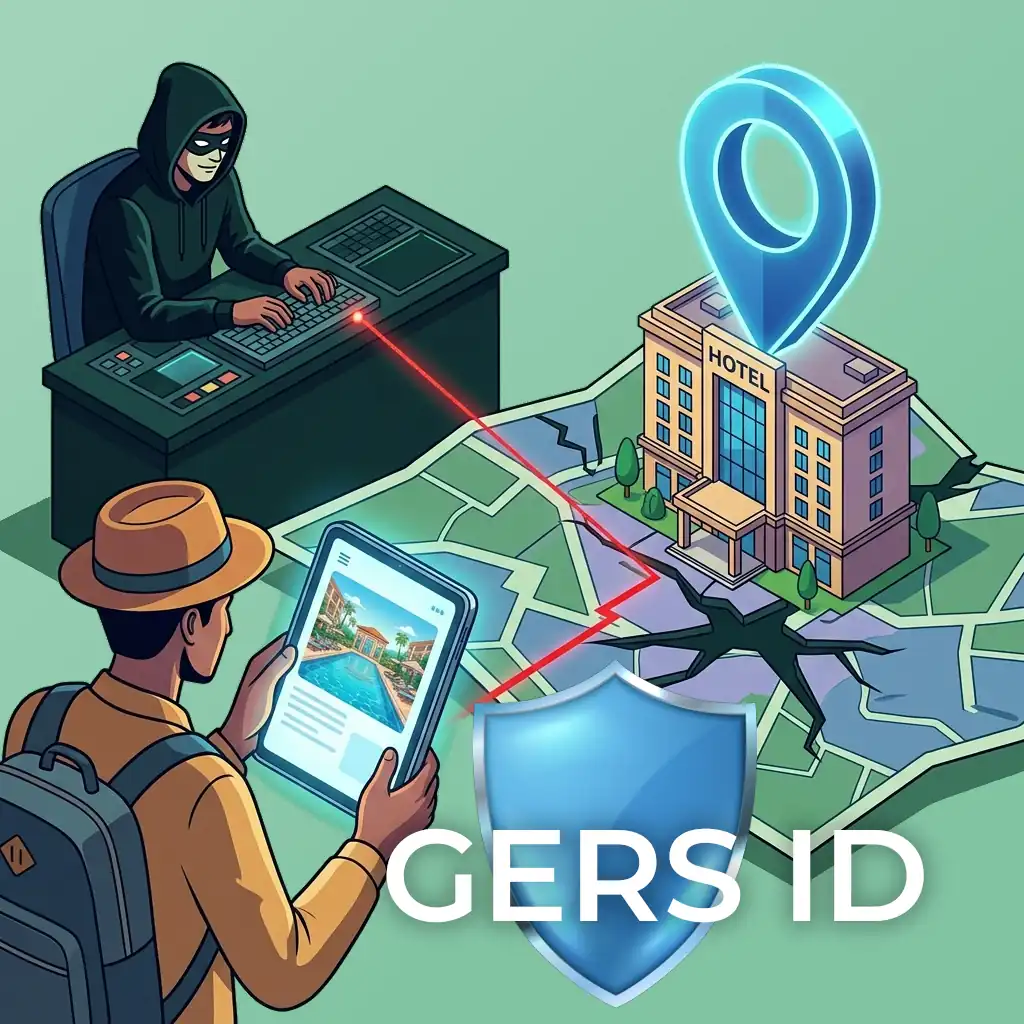
AI travel assistants are increasingly recommending fraudulent hotel booking websites to travelers. As AI search engines replace traditional search results, scammers are using Generative Engine Optimization (GEO) to manipulate LLMs into surfacing cloned travel sites. GERS IDs from Overture Maps may offer a new identity verification layer that helps AI systems distinguish legitimate travel businesses from phishing operations.
Key Takeaways
- AI search engines are increasingly recommending hotels, airlines, restaurants, and experiences directly to travelers.
- Fraudsters are using Generative Engine Optimization (GEO) techniques to manipulate AI systems into recommending fake booking websites.
- Traditional trust indicators like verified domains and business authority are often hidden inside AI-generated answers, making fraudulent links harder for travelers to detect.
- Overture Maps’ Global Entity Reference System (GERS) gives AI systems a persistent identity layer tied to real-world physical locations.
- GERS IDs can help AI systems establish stronger confidence that a booking domain is associated with the real-world business entity.
- By grounding AI recommendations in authoritative geospatial data, GERS can reduce hallucinations, impersonation, phishing, and fraudulent travel recommendations.
- Hotels and travel operators can expose GERS IDs through Agent-to-Agent (A2A) agent cards, enabling trusted AI-to-AI travel interactions and improving “Reverse Discoverability.”
What is a GERS ID?
A GERS ID is a persistent geospatial identifier developed by Overture Maps that connects digital systems to real-world physical entities.
In travel and hospitality, GERS IDs function as globally persistent property identifiers that help reduce booking errors, simplify reconciliation, and accelerate partner onboarding.
Why AI Travel Search Creates New Fraud Risks
The way people plan travel is shifting fast. Instead of scrolling through pages of blue links, 26% of travelers now start their hotel research on OTA platforms to avoid the misleading rates often found in traditional search ads.1 At the same time, AI assistants are starting to do the heavy lifting of researching and comparing accommodations for users.
However, a dangerous gap exists in this new web architecture. AI models are often confident but gullible. They can be manipulated into recommending fraudulent, cloned websites that look exactly like a legitimate hotel or airline. When an AI "Answer Engine" directs a traveler to a fake booking page, the financial and reputational damage is immediate.
The industry needs a way to anchor digital identities in physical reality.
How Fraudsters Use GEO to Manipulate LLMs
Scammers no longer need to be expert coders. They use AI website builders to scrape the logos, colors, and layouts of major travel brands in minutes.5 Once they have a perfect clone of a hotel or airline site, they use Generative Engine Optimization (GEO). This is a new way to trick Large Language Models (LLMs) into thinking a fake site is the most authoritative source.
By embedding specific AI-friendly markers, statistical citations, and fake expert quotes, these criminals ensure their malicious links appear at the top of AI-generated summaries. The effectiveness of these attacks is startling. Traditional phishing emails had red flags like typos; AI-generated clones have none. They use brand-accurate typography that feels indistinguishable from legitimate marketing. Research shows that:
AI-generated phishing links achieve click-through rates as high as 54%, 4× more effective than old manual methods.
Why AI Search Engines Recommend Fake Travel Websites
The problem is systemic. AI search engines often strip away the traditional safety signals that humans rely on, such as domain authority or verified snippets. In 2025, researchers at Netcraft tested several AI models by asking for the login pages of fifty major brands. The results were concerning: the AI models provided incorrect or illegitimate URLs 34% of the time.7
In one specific case, Perplexity recommended a malicious Google Sites page while pretending it was a legitimate financial portal. Because the AI presents these answers with professional clarity, travelers follow the link without a second thought. For the travel industry, which is a top-three target for AI-driven traffic, this creates a "trust cliff."
If a guest books a room that doesn't exist through an AI recommendation, they are losing money and faith in the entire booking ecosystem.
The Scale of Travel and Hospitality Fraud in 2025
Fraud in the hospitality and travel sectors has reached a tipping point. Global losses related to financial fraud reached $442 billion in 2025. Within travel, airlines are hit the hardest, accounting for 46% of all fraudulent transactions globally.9 The cost of these scams isn't just a line item on a balance sheet; it represents a 7.7% drain on annual revenue for global businesses. In the United States, that figure is even higher at 9.8%.
How GERS IDs Verify Real-World Travel Businesses
Today’s AI travel workflows often lack a reliable identity verification layer to confirm whether a recommended booking website actually belongs to the real-world business being referenced.
In a typical failure case, an LLM:
- identifies a hotel name
- discovers a high-ranking or GEO-optimized URL
- incorrectly interprets that site as authoritative
- returns the fraudulent booking link to the traveler
Closing this gap requires a shared, open reference for what exists in the physical world, kept current and structured for machines to reason over. This is what Overture Maps and its members (Microsoft, TomTom, Amazon AWS, Meta, BrightQuery, Esri, and others) are building.10
A GERS ID acts as a digital anchor tied to verifiable geospatial data, provenance metadata, and confidence signals that AI systems can reason over.
By assigning a GERS ID to a physical business, Overture creates a verifiable identity layer for hotels, restaurants, airports, and other real-world locations.10 This grounding gives AI systems clear geospatial context and signals they can use to evaluate whether a website or agent is legitimately associated with a real-world entity.
With GERS, the workflow changes fundamentally. Instead of relying only on manipulated web signals, AI systems can:
- identify the real-world travel entity
- resolve its persistent GERS ID
- retrieve the canonical website associated with that entity
- compare the recommended URL against trusted records
- detect mismatches and suppress suspicious domains
Overture also provides auditable metadata such as source, license, timestamp, and calibrated confidence scores based on accumulated signals.12 This allows LLMs to reason about uncertainty, reduce hallucinations, and make large-scale impersonation and phishing attacks significantly harder to recommend confidently.
GERS does not eliminate fraud entirely. Its effectiveness depends on broad ecosystem adoption and accurate linkage between entities, domains, and agent identities. However, it creates a substantially stronger verification foundation than today’s largely trust-based AI retrieval systems.
Using “Bridge Files,” businesses can link existing internal systems to open GERS IDs without rebuilding their infrastructure.10 This creates a web of trust where digital identity is tied to physical reality, making it substantially harder for scammers to impersonate legitimate travel businesses.
Grounding AI Agents for Reverse Discoverability
For travel and hospitality companies building with GERS and AI agents, security must extend to the agent itself. It is a best practice for these organizations to ensure that their Agent-to-Agent (A2A) agent cards include a GERS ID. These cards are JSON files published at a standard URL that act as a digital profile for the agent. By exposing its GERS ID through the agent card, a hotel allows remote parties and LLMs to verify if the agent has actually been issued for the physical place it claims to be associated with.
This mechanism enables "Reverse Discoverability". When a guest's AI agent communicates with a hotel's AI agent, it can perform a real-time check against the geospatial grounding in the map. This verification connects the agent to a real-world business with a verifiable physical presence. Including GERS IDs in A2A agent cards makes hotels discoverable through agents with much higher trust. In an AI-driven travel ecosystem, verifying real-world identity becomes part of the security model.
By anchoring digital agents to physical GERS IDs, the travel industry is reclaiming the maps for real businesses and real people.
Building Trusted AI Infrastructure for Travel & Hospitality
As AI assistants increasingly influence how travelers discover and book hotels, restaurants, and experiences, the industry needs stronger ways to verify that digital recommendations are tied to real-world businesses. Geospatial identity systems like GERS create a foundation for that trust by helping AI systems anchor websites, agents, and transactions to authoritative physical entities.
inHotel adopts GERS IDs natively across its AI and hospitality infrastructure, helping travel companies map verified property identities, associate trusted AI agents, and maintain authoritative geospatial metadata across booking and discovery systems. This grounding layer helps AI agents represent the correct business, preserve transactional context, and reduce the risk of impersonation and phishing across AI-driven travel experiences.
Learn more about GERS Property ID & Location Intelligence.
Sources
- The Paypers' Travel Series – key takeaways from industry experts
- Switzerland's NCSC boosts operational capabilities
- There's a fake version of your hotel taking bookings right now
- GERS - Global Entity Reference System - Overture Maps
- Criminals are using AI website builders to clone major brands - Malwarebytes
- GERS: Global Property IDs for Hospitality and Travel
- Large Language Models (LLMs) Are Falling for Phishing Scams: What Happens When AI Gives You the Wrong URL?
- Overture and the OpenTravel Alliance
- Passport to Scam Island: Fraud in the Travel Industry (2026)
- Three Years In: How Overture Maps is Changing the Way the World Builds Maps
- FBI's 2025 Annual Cybercrime Report
- From Discovery to Action: A New Foundation for Travel - Overture Maps
- AI-Driven Scams Cost Americans $893 Million
- Crypto Scams and Senior Fraud Drive $21 Billion in 2025 Cyber Theft
Frequently Asked Questions
How can hotels prevent AI assistants from recommending fake booking websites?
Hotels need more than domain monitoring. AI assistants may surface a cloned booking site if it looks authoritative in search or retrieval systems. A better defense is to connect the hotel’s official domain, booking flow, AI agent, and physical property to a persistent geospatial identity such as a GERS ID. This gives AI systems a reference point to check whether a recommended URL is actually tied to the real-world hotel before sending a guest there.
Why are AI travel scams dangerous for hotel owners and operators?
AI travel scams damage hotels long before a guest arrives at the property. A traveler may book through a cloned website, lose hundreds or thousands of dollars, and still blame the hotel when the reservation cannot be found. The financial impact is already significant. Global businesses now lose an average of 7.7% of annual revenue to fraud, rising to 9.8% in the United States. Hospitality is especially exposed because AI-generated answers often hide the trust signals guests normally rely on, including verified snippets, domain history, and review provenance. Hotels increasingly need machine-readable identity signals that help AI systems separate legitimate properties from impersonators.
What is a GERS ID and why does it matter for hotels?
A GERS ID is a persistent geospatial identifier from Overture Maps that links digital systems to real-world places. For hotels, it can act like a stable property identity across booking systems, AI agents, maps, and partner platforms. Instead of relying only on a hotel name or web address, AI systems can use the GERS ID to recognize the actual physical business. That helps reduce confusion, impersonation, and booking errors when travelers use AI search.
How do fake hotel websites manipulate AI search results?
Fake hotel websites increasingly use Generative Engine Optimization, or GEO, to influence how large language models rank and summarize information. Scammers can now clone a hotel website in minutes using AI website builders, then flood the page with AI-friendly formatting, fake authority signals, fabricated citations, and convincing booking language. Research shows AI-generated phishing campaigns achieve click-through rates as high as 54%, roughly four times more effective than older manual phishing tactics. That means a cloned hotel site can appear trustworthy enough for an AI assistant to recommend directly to travelers.
Can AI search engines verify if a hotel booking website is legitimate?
Not reliably on their own. In one 2025 study, researchers found AI models returned incorrect or illegitimate URLs 34% of the time when asked for login pages tied to major brands. The issue is structural. AI systems are good at summarizing content but often weak at validating ownership. If a fraudulent booking page copies a hotel’s branding, imagery, and tone, the model may still present it confidently as legitimate. Stronger verification requires trusted records tied to the actual property, including canonical domains, geospatial identifiers, provenance metadata, and confidence scoring.
How can hotels protect direct bookings from AI-driven fraud?
Hotels should treat AI discovery as part of the booking funnel. If an AI assistant sends a guest to the wrong website, the direct booking is already lost. Protection starts with mapping the property’s verified identity to its official website, booking engine, location records, and AI-facing metadata. When those signals are structured for machines, AI systems have a better chance of choosing the legitimate booking path instead of a cloned page built to steal payments.
Why is traditional SEO not enough to protect hotels in AI search?
Traditional SEO was built for search result pages that humans inspect. AI search works differently. It summarizes, recommends, and often removes the visual clues people use to judge trust. A scam site does not always need to outrank a hotel in classic Google results to appear in an AI answer. Hotels now need SEO plus entity verification: persistent IDs, canonical domain records, location metadata, and AI-readable trust signals tied to the physical property.
How can hotel AI agents prove they represent a real property?
Hotel AI agents should expose a verified property identity, ideally through an Agent-to-Agent agent card that includes a persistent geospatial reference such as a GERS ID. That gives a traveler’s AI assistant something concrete to check. Is this agent tied to the real hotel at the claimed location, or is it just pretending? As bookings move toward AI-to-AI interactions, this kind of verification becomes basic hygiene, like locking the front desk cash drawer.
What is Reverse Discoverability in AI travel search?
Reverse Discoverability means a hotel can be found and trusted by AI agents because its digital identity points back to a verified real-world property. In practice, a guest’s AI assistant could check a hotel agent’s published identity, resolve its geospatial reference, and confirm that it matches the correct place. This is especially useful in hospitality, where names, addresses, booking domains, and third-party listings often get messy across platforms.
How should hotels prepare for AI-first travel discovery?
Hotels should make their official identity easy for machines to verify. That means connecting the property, website, booking engine, agent card, maps data, and trusted metadata around a persistent real-world identifier. It is not glamorous work, but it matters. The hotels that prepare early will be easier for AI assistants to recommend with confidence, while fake sites and impersonators will face a higher bar to look legitimate.