Guest Directory AI Agent Skill for Hotels: Promo + Giveaway
Launch offer for hotels: get Guest Directory from €20/month, unlock major AI assistant discounts, and enter to win a free Premium plan for 12 months.



Overview
A guest’s trip is rarely ruined by a single disaster. Instead, it is usually a slow accumulation of tiny, annoying frictions that makes them feel like they are working way too hard for their vacation. When someone spends a few hundred Euros on a room, they do not want to play detective to find the pool hours or wait five minutes on hold for the front desk to pick up. They want to be in the flow of their trip.
Every time guests hunt for basic info, your 5★ rating slips toward 4, or 3.
Those three or four star reviews are the silent killers of your reputation. Micro-frustrations signal to future travelers that your property is just a bit of a hassle.
To fix this, we built Guest Directory, a new AI agent skill for the Guest Relations Assistant.
To celebrate the launch, we are running a special May campaign with major discounts and a free Premium plan giveaway. It is a practical way to stop your reputation from bleeding out through minor inconveniences.
New Guest Directory launch offer for hotels
From May 1 to May 31, 2026, you can claim heavily discounted Guest Relations Assistant plans after grabbing the new Guest Directory skill and completing one simple campaign step.
One participant will also win a Premium Assistant free for 12 months, which is a €2,399 value.
How the assistant and skills actually click together
Think of the Guest Relations Assistant like a new hire. It arrives knowing hospitality best practices, but the real value kicks in when you walk it through your property. You teach it your objectives, policies, and procedures once, and it applies that knowledge across every task.
"Skills" are just the specific jobs you hand off to it.
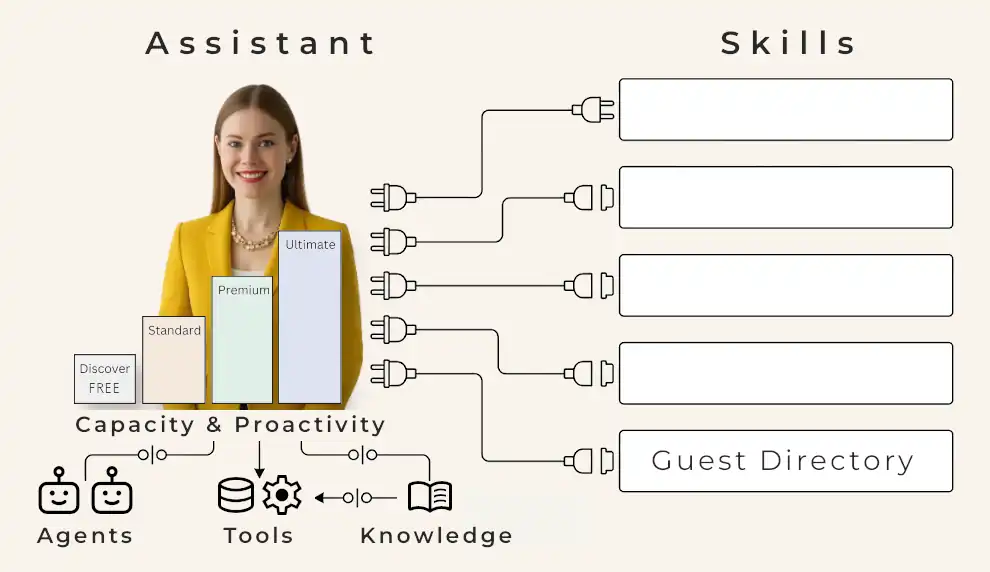
For example, the Guest Directory is the skill that handles in-room QR code inquiries. You can add skills for website chats or in-stay requests. It is the same assistant every time, just doing different work for you.
This architecture offers two major advantages:
- Reduced Costs: Stop paying multiple vendors for redundant overhead. You pay for one core infrastructure (assistants) and only add the specific value-adds you need (skills).
- Unified Data: There is only one place to train all your AI agents. You never have to update the same info in three places or jump between five different systems.
You simply manage one "employee" and keep adding to its plate as you get more comfortable.
What Guest Directory actually does
Think about that printed guest directory sitting in a desk drawer. It is usually a relic. It goes out of date the moment a menu price changes, it gets ignored, and staff eventually stop bothering to update the crumpled pages. Guests end up calling reception anyway because it is easier than digging through a binder.
Now, replace that frustration with a QR code. A guest walks in, scans the code, and asks their phone:
What time is breakfast tomorrow?
Do you have parking?
How late is the gym open?
Can I book a massage?
What is the Wi-Fi password?
They get an instant answer in their own language. No waiting. No searching. No phone calls to a busy desk.
And it gets smarter than a static FAQ. With the Guest Directory skill, the AI agent can adapt its behavior based on where the guest is. A guest in the lobby may ask about check-out or luggage storage. A guest in the room may need Wi-Fi or room service. On your executive floor, the AI directs them to the club lounge. Same assistant, different context, more relevant answers.
Why your team will thank you
Managers often try to solve service pressure by telling the team to just "be more efficient". Usually, that doesn't fix the root issue. The issue is repetition. When your staff stops answering the same ten questions twenty times a day, they can actually focus on arrivals, special requests, and genuine hospitality.
Faster answers for guests
Fewer repetitive calls and interruptions
Better review scores
Higher visibility for paid services like the spa or bar
No more printing or manual directory updates
Better ratings mean real revenue growth
Some hoteliers still treat reviews as vanity metrics. That is expensive thinking. As research shows, reputation directly affects revenue.
- A 1% increase in a hotel’s reputation score can lead to about a 0.89% increase in ADR
- Occupancy can rise by around 0.54%
- RevPAR can climb by roughly 1.42% for every 1-point gain on a 100-point scale
And guest behavior is even more brutal than most operators realize:
- 88% of travelers filter out hotels below 3 stars
- 33% filter out anything below 4 stars
- When prices are equal, guests are 3.9 times more likely to book the higher-rated option
So a move from 3.9 to 4.0 is not cosmetic. It can determine whether your hotel even shows up in the shortlist.
AI Guest Directory costs €20 and delivers 14× ROI
Let’s look at a typical 50 room property at 70% occupancy. That is roughly 1,050 occupied room nights per month. If giving guests easier access to info lifts your reviews slightly and prevents even a couple of "frustrated" ratings, the value adds up fast:
Reputation and experience impact: ~€200
Service discovery (spa/room service): ~€60
Printing and admin savings: ~€20
Estimated value: ~€280/month
Cost of Guest Directory: €20/month
ROI: 14×
The return on investment is immediate because better reviews enable you to protect your premium pricing.
Campaign offer: massive assistant discounts
To join the May campaign, complete these three steps during the validity period.
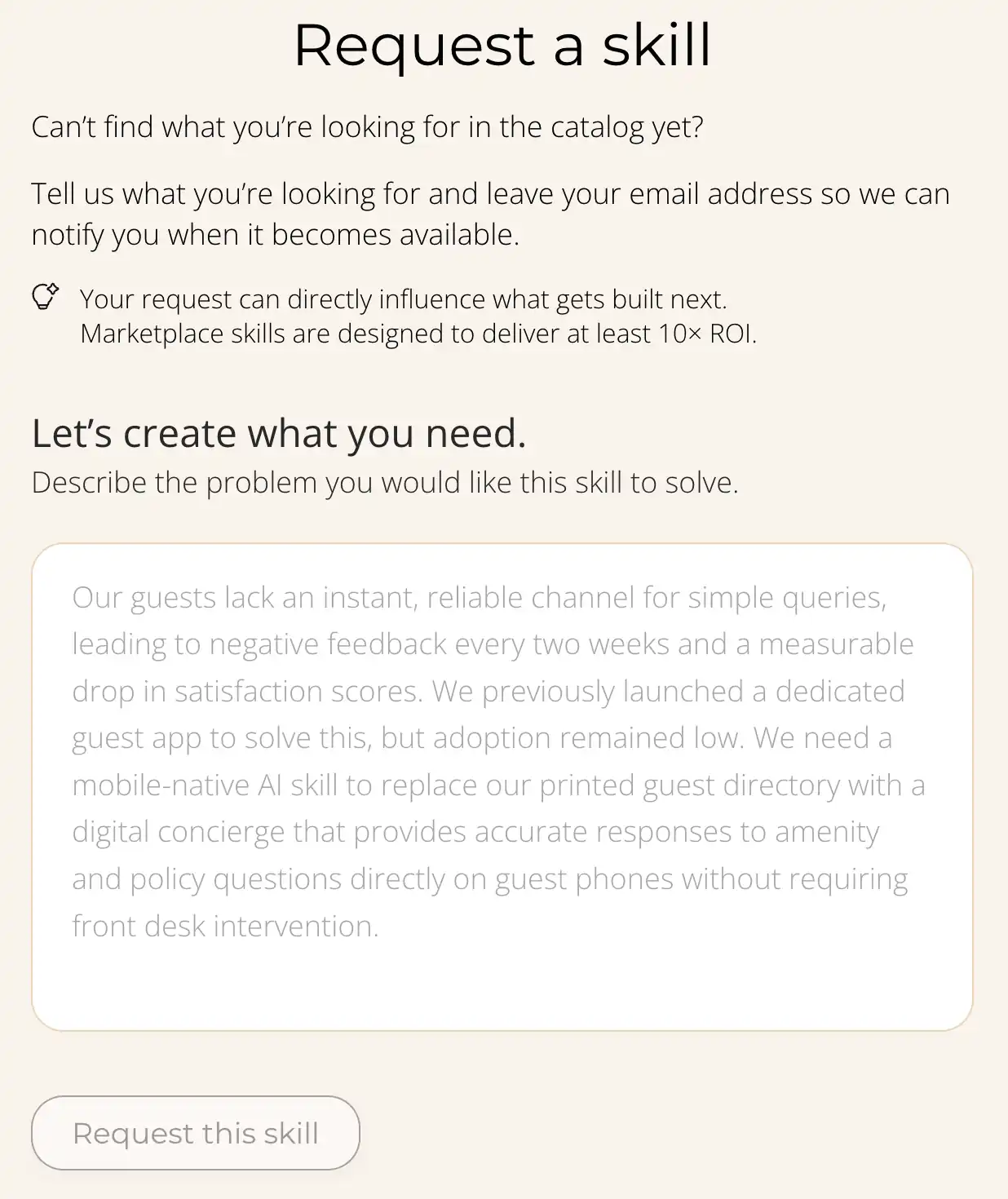
Step 1: submit a new agent skill idea
Submit a new skill creation proposal to influence which AI skill we or the community of hospitality expert creators should build next. It takes 5-10 minutes.
Step 2: purchase Guest Relations Assistant
On your Guest Relations Assistant portal page, go to Contract > Compensation, and claim one of these campaign discounts:
Note: Remember to enter the coupon code at checkout.
Step 3: let your assistant learn the Guest Directory skill
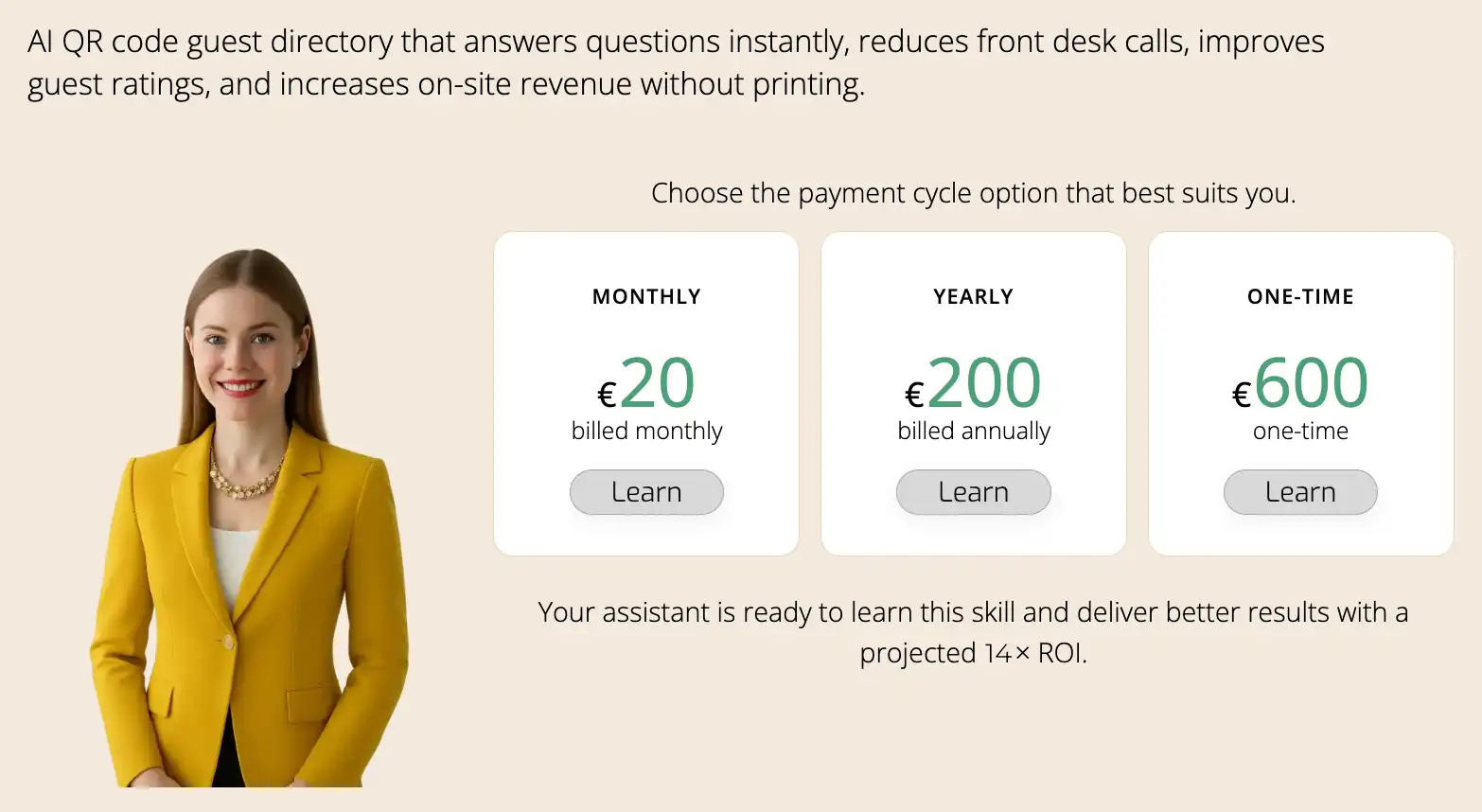
On your Guest Relations Assistant portal page, go to Skills > School, then choose the billing option that suits you: €20/month, €200/year, or a €600 one-time payment for lifetime access.
Free Premium giveaway (value €2,399)
Every eligible campaign participant goes into a draw.
One lucky winner gets a Premium Assistant of their choice free for a full year.
A practical starting point for smaller properties
Guest Directory also works with the free "Discover" plan of the Guest Relations Assistant, which makes it an easy starting point for short term rentals, guesthouses and B&Bs that want to improve the guest experience without a substantial financial commitment.
That said, the free plan comes with lower limits on knowledge capacity, conversation volume, system integrations and the number of skills your assistant can learn.
For most hotels, Standard or Premium is the more realistic fit, which is exactly why this campaign is such a strong opportunity to snap a higher-tier assistant plan at a discount.
One assistant for website and in-house guests
The best part is that this isn't just for the rooms. The Guest Relations Assistant is commonly used as a website chatbot too. The same system can help a future guest with pre-stay questions on your site and then help that same guest via a QR code once they check in. In small properties, it avoids the mess of buying five different tools for five different touchpoints.
Why do this right now?
A lot of hotel owners wait to try AI because they imagine a painful, expensive project that takes months to set up. That is not necessary. A practical first move is always better than a "grand plan" that never actually starts.
Give your guests faster answers, reduce the noise at the front desk, and stop letting small issues eat your ranking and impact your revenues. May is the month to do it while the barrier to entry is this low.
Campaign period: May 1 to May 31, 2026
Frequently Asked Questions
Is now a good time to invest in an AI guest communication tool for my hotel, or should I wait?
Waiting usually feels safe, but in this case it is expensive. Guest expectations have already shifted toward instant answers, and the hotels that move first tend to lock in better reviews and stronger positioning. What makes this moment different is the low entry cost combined with discounted access to more advanced capabilities. You are not committing to a large system overhaul. You are testing something practical, at a reduced price, during a limited window.
How can I decide if an AI guest communication tool is worth trying in my hotel right now?
The decision is less about technology and more about timing. If your team is answering the same questions all day, or guests seem lost once they enter the room, you already have a clear signal. The current promotion lowers the barrier to act on that signal. Instead of debating for months, you can try a working setup during a discounted period and base your decision on real guest behavior rather than assumptions.
What makes a limited-time promotion on hotel AI tools actually worth acting on?
Most software discounts are just pricing tactics. The Guest Directory AI agent skill reduces the risk of trying something new. You are not just getting a lower monthly fee. You are accessing higher-tier capabilities at a price point that normally would not justify experimentation. If the tool improves response speed and guest flow, it pays for itself quickly. If it does not, you have minimized your downside during the test period.
Should small hotels use AI guest communication tools differently than larger properties?
Yes, and this is often overlooked. Smaller properties do not need complex systems. They need something that removes friction fast. A lightweight setup that answers guest questions instantly can already shift reviews and reduce workload. Larger hotels, on the other hand, hit capacity limits quickly and benefit more from higher-tier plans. The key is starting at the right level, not overbuying or underestimating your needs.
How can I combine a hotel website chatbot and in-stay guest messaging into one AI system?
This is where many setups fall apart. One tool handles pre-booking questions, another handles in-stay communication, and neither talks to the other. A unified assistant solves that by serving both roles. A guest asks about parking on your website, then later scans a QR code in their room and continues interacting with the same logic. It feels consistent. For your team, it means fewer systems and less duplicated content to manage.
What is the real risk of delaying adoption of AI guest communication tools in hotels?
The risk is not that competitors will have better technology. It is that they will remove friction faster than you. Guests compare experiences across properties without thinking about your internal setup. If one hotel answers instantly and another makes them wait, the difference shows up in reviews. Over time, that affects ranking, pricing, and occupancy. Delaying adoption often looks harmless in the short term, but compounds quietly.
What early signs show that an AI guest directory is paying off after implementation?
You will notice it quickly if you are paying attention. The front desk phone rings less for basic questions. Guests stop lining up just to ask for Wi-Fi details or breakfast times. Staff interruptions drop, and conversations shift toward actual service instead of repetition. These are not abstract metrics. You can see and feel the difference during a normal shift. Those early changes are often enough to justify the investment long before reviews start reflecting the improvement.
What should I prioritize when choosing between AI guest communication tools during a hotel promotion?
Ignore feature lists for a moment and focus on one thing: does it remove friction in real guest interactions? If the answer is yes, it will likely impact reviews and revenue. Look for fast setup, no app download, and clear usefulness from day one. Promotions can be distracting, but they are valuable when they let you access a better version of the product at a lower risk point.
Does a limited-time promotion on a hotel AI guest directory make sense for long-term adoption?
It can, if you treat it as a structured trial rather than a quick purchase. Use the promotional period to observe guest behavior, staff workload, and service flow. If it works, you continue with confidence. If not, you exit without having committed at full cost. The timing matters because it lets you test something operationally meaningful while the financial barrier is lower than usual.
What usually triggers hotels to finally adopt AI guest communication tools?
It is rarely a strategic roadmap. More often, it is a breaking point. Staff gets overwhelmed with the same questions all day. Reviews start mentioning slow responses or confusion. And then there are the quieter signals. Guests leave 4 or 3 stars without pointing to any major issue, just a vague sense that the stay felt harder than it should have. That is often the real trigger. The difference now is that you do not have to wait for that slide. A low-cost, time-limited offer gives you a reason to act before the damage shows up in your rankings.