AI Agent Skills Automate Hospitality Operations
Turn hospitality know-how into AI agent skills, cut SaaS costs by 3× with 10–15× ROI, while creators monetize prompts and workflows with 80% revenue.



What if you could send your AI agent to school?
That’s the simplest way to think about what we’re launching today.
Agent skills is a new way to teach AI how hospitality actually works. Not in theory. Not based on generic workflows. But based on how real operators run real properties.
Why traditional hotel tech architecture fails the industry
The pattern hasn’t changed in years. A vendor builds a tool, packages it and sells it. Hotels buy it. Then spend weeks or months bending their operations around it.
Vendors are following the exact same path with AI. They are building chatbots and agents, wrapping them into siloed, single-purpose products, and selling them back to hotels. The result is familiar: high costs, limited flexibility, and tools that don’t quite fit how things work on property. We think that approach is backwards.
With agent skills:
- Operators define the problems
- Experts build the solutions
- Operators pick exactly what they need
No bloated systems. No guesswork from vendors.
AI that does what you actually want it to do.
What agent skills really are
A skill is simply a piece of work that someone in your team would normally do.
That could be answering guest emails.
Or deciding whether to accept a group booking.
Or adjusting restaurant menus to match seasonal demand.
Some of that work is repetitive and tedious. Some of it requires years of specialized experience.
That’s exactly where skills come in. They let an AI agent step in and execute that work properly. Not as a shortcut. As a trained operator would.
This matters because hotels are constantly short on people and specialized expertise. You don’t always have a senior revenue manager on site. Or a digital marketing expert. Or someone who really understands the financial implications of a decision.
With skills, you don’t have to hire for every gap. You equip your staff with a skilled assistant that lets them operate at a higher level, without needing years of experience in every function.
How skills get created and monetized
This isn’t a closed system where a vendor decides what gets built. It starts with operators. You identify a gap. Something that takes too long. Something that’s hard to get right. Something you wish a system could just handle.
From there, skills can be created in different ways. You can build them yourself. You can work with an expert. Or you can rely on inHotel and partners to develop them.
And here’s where it gets interesting.
You can build a skill for your own property, use it internally, and then publish it for others.
That changes the economics completely. Instead of paying for software that only you use, you create (or fund) something that other hotels can adopt. If they do, you earn 80% of the revenue generated by the skill.
What used to be IT cost becomes a revenue stream.
You don’t need to be technical to participate
There’s a misconception that building AI capabilities requires engineering teams. In many cases, it doesn’t.
At the simplest level, a skill can just be a well-structured prompt. If you’ve ever built a custom GPT or written a few comprehensive SOPs, you already understand the basics.
You define the task clearly. You structure the logic. You package it as a skill. That’s it.
From there, it can be published and reused by others. Or not. That part is entirely up to you. You can keep a skill strictly for your own operations. You can share it more selectively, for example, with properties within your brand. Or you can publish it in non-competing markets or broadly through the marketplace and monetize it. You decide how far it goes.
Turn your best prompts into skills. Distribute them. Get paid.
Skills are compatible with Anthropic’s Open Skills format, which means they can be imported, exported, and reused across different environments. You’re not building something that’s locked into one platform.
Of course, more advanced skills go further. They include workflows, decision logic, system tool interactions, and define how the user interacts with them. But the entry point is deliberately simple so that people who actually understand hospitality can contribute.
Your work stays yours
One concern comes up quickly when people hear about this: “If I build something valuable, like an advanced prompt, and share it, what stops others from copying it?”
Skills on inHotel are packaged in a way that keeps the underlying logic hidden. The prompts, the workflow structure, the “how” behind the skill are not exposed.
Agent skill creators share the capability, but keep the intellectual property.
What’s actually happening under the hood
From the outside, a skill looks simple. You give an instruction or an event triggers. The agent does the job.
Behind the scenes, there’s more going on.
Skills rely on prompts that adapt to the property they’re used in. The same skill adjusts to your brand voice, your policies, and your way of doing things. You don’t need to rebuild it for every hotel. It fits the environment it’s dropped into. It’s similar to how an experienced employee joins a new hotel. They don’t relearn the job from scratch. They pick up the standards, the tone, and the processes, and get up to speed quickly.
Then there’s execution. A skill isn’t just a single response. It can run through a full workflow. Make decisions, pull data, trigger actions.
And it doesn’t operate in isolation. A skill can either require a specific system or work with whatever system is available.
A concrete example: guest check-in
Think about check-in.
Every hotel has a slightly different process. Different PMS. Different brand rules. Different upsell strategies.
Now imagine a guest service expert defines what a perfect check-in looks like. Not just the steps, but the judgment calls. When to upsell. How to handle edge cases. What to prioritize.
That becomes a skill.
In one hotel, that skill might be set up to work directly with a specific PMS.
In another, the agent simply detects which PMS is connected and uses that.
From the staff’s point of view, it’s straightforward.
A seasonal employee arrives. Minimal training. They tell the agent to perform a check-in.
The agent executes it properly. Every time. Following the defined standard. Using the right system. The staff member stays in control. They just don’t have to figure everything out from scratch. No guesswork. No inconsistency depending on who is on shift.
How people and systems interact with skill-enabled agents
There isn’t a single interface for using skills. That flexibility is intentional. In most cases, staff will use inHotel’s AI Search interface. They select a skill, provide the required input, and run it. It’s very straightforward.
On websites, the same interface can be embedded and pre-configured. A skill can be enforced through a URL parameter, which means you can control exactly how people interact with the agent in a given context.
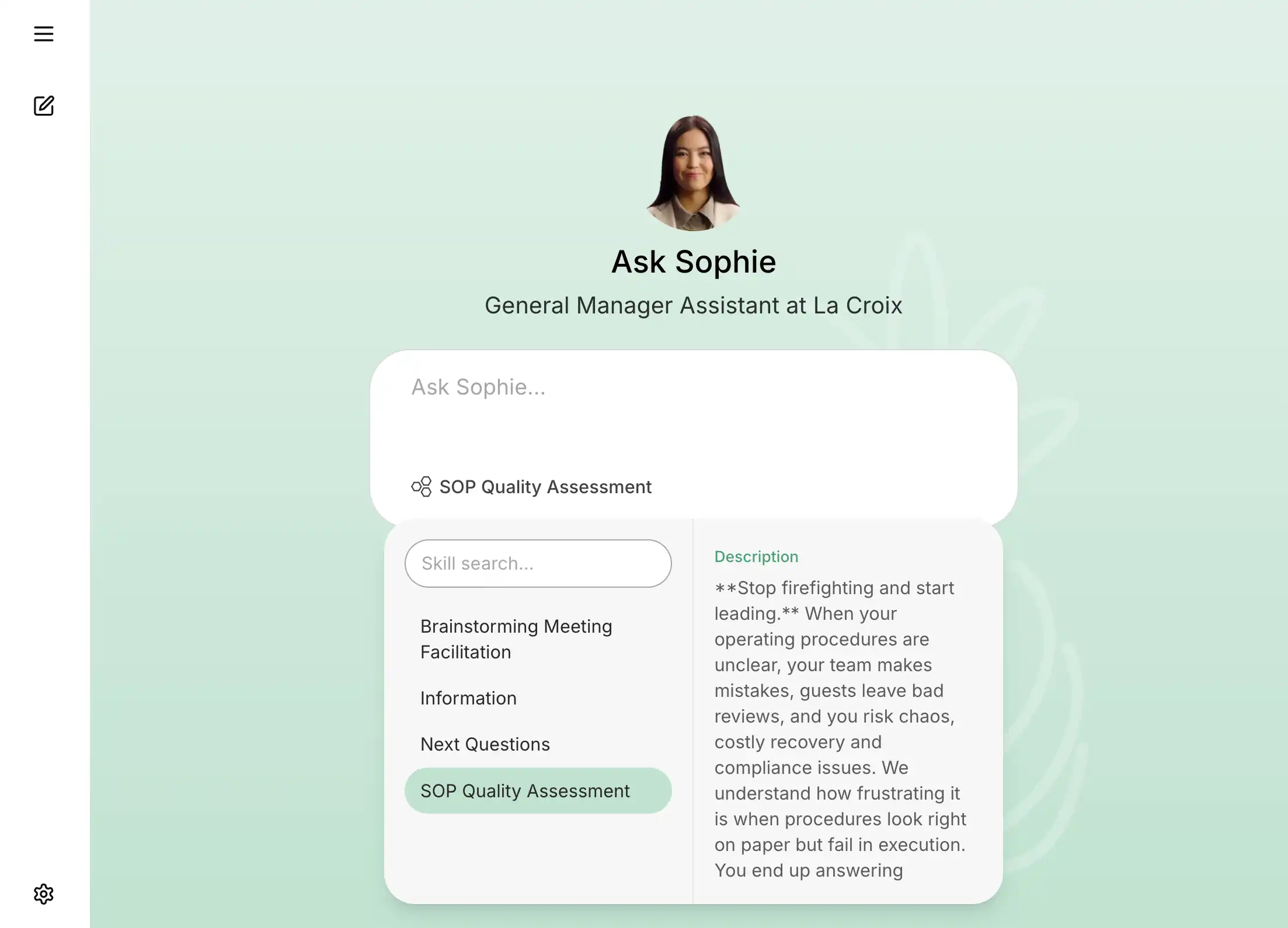
On mobile, the same principle applies. With Mobile Chat, operators can enforce specific skills for specific situations. For example, in-house guests can be routed directly to a Guest Relations agent using a Guest Directory skill that is tailored to their stay.
Agents can also interact with each other. When one agent communicates with another through the open agent-to-agent (A2A) protocol, skills can be invoked as part of that interaction.
In more open-ended interfaces, like a website chat widget or a context-aware Focus Chat, the agent currently defaults to a general “Information” skill. Over time, this will evolve. Agents will automatically select the most appropriate skill based on the request and context.
One set of skills, across every agent interface.
Skills AI-enable hospitality software, expand reach
There’s another layer to this that matters for hospitality software vendors: Skills can require specific tools to function. That means a skill can effectively sit on top of an existing system and drive usage into it.
Instead of selling software in isolation, vendors can distribute functionality through skills. The agent becomes the interface, while the software continues to operate behind the scenes. But this is not just a new distribution channel. It is also a practical way to make existing software AI-native.
PMS, RMS, CRM, and other hospitality tech vendors: You don’t need to rebuild your product or bolt on a lousy chatbot to appear AI-powered. If your system already exposes APIs or runs through an MCP server, you can build a skill on top of it. The skill acts as the layer that translates user intent into structured actions, while your software executes those actions as it always has.
In practice, this means your product becomes accessible through an agent without changing its core architecture. The agent handles the interaction, selects the appropriate skill, and routes execution to your system when needed. Your software remains the engine, but it is now part of an AI-driven workflow.
Make your software AI-native without rebuilding it.
Why the skill model is significantly cheaper than SaaS
Most hotel software is expensive for a simple reason. You’re paying for the same foundation over and over again: infrastructure, integrations, data security, marketing, user support, general admin. Every vendor has it and charges for it.
But that’s not what you actually care about. You care about the 20% that solves your problem. With skills, that layer is separated: There is one shared infrastructure. Then there are skills on top that do the actual work.
So instead of paying 100% every time, you pay once for the foundation and then for the specific capabilities you need. No overhead.

Agent Skills cut SaaS costs by ~3× by eliminating duplicate infrastructure.
Integration is not a problem anymore
Most hotel IT managers hear about new tech and think the same thing: “Great. Another system to integrate.”
That’s not what this is.
You already run 30 to 40 systems, many of them connected in fragile ways. Instead of adding another layer of integrations, you connect once, and the agent handles the rest.
inHotel provides a secure and governed, universal tool connector that sits between the AI assistant and your systems (PMS, CRM, and others). You connect the assistant once, just like you would for a staff member, and it uses that connection to execute skills. Same as people do.
Agent Skills make your tech stack simpler over time.
Value-based pricing with 10–15× ROI for every skill
There’s a rule that applies to every skill on inHotel: If it creates €1,000 in value, it shouldn’t cost more than €100.
This isn’t a marketing claim. It’s enforced. Skill publishers also provide the calculation logic so you can model ROI in your own environment.
You get predictable returns, typically in the range of 10 to 15 times the cost.
This keeps the marketplace focused on what actually moves the needle. Not features for the sake of features.
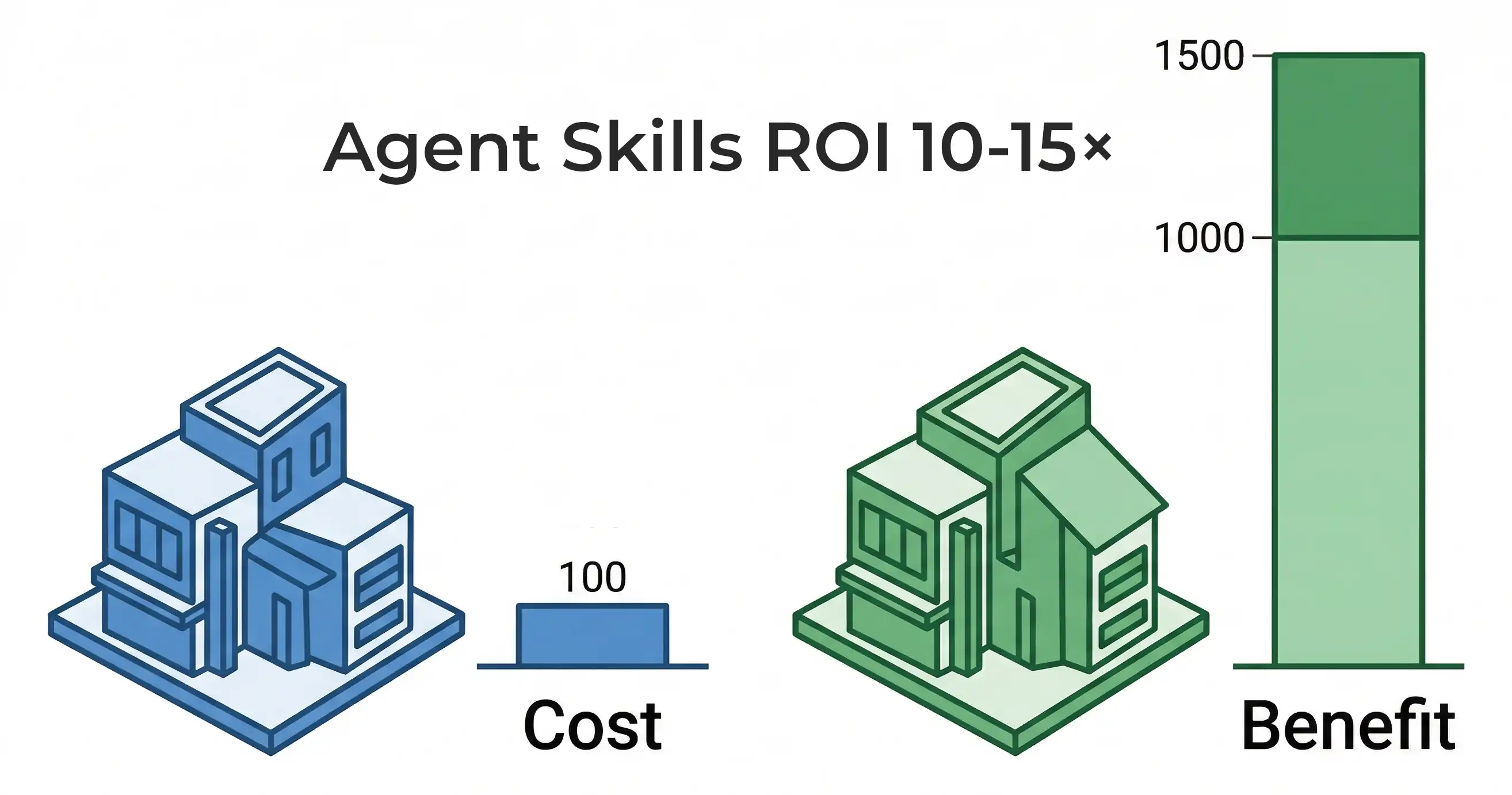
For a concrete example, see the Group Displacement skill ROI breakdown. In a typical scenario, improving just a few group decisions per month can protect ~€975 in transient revenue, while automating evaluation saves ~€360 in labor. That’s ~€1,335 in monthly impact against a €95 cost, or ~14× ROI. Most of the value comes from avoiding a single poorly accepted group during high-demand periods, where margin loss can quickly reach thousands.
Every paid skill must deliver at least 10–15× its cost in value.
One place for all your operational knowledge
Most hospitality operators have knowledge scattered everywhere.
A bit in a guest messaging tool.
A bit in a maintenance ticketing system.
A bit in someone’s head.
Every new tool adds another silo.
With inHotel, that knowledge sits in one place. Policies, SOPs, brand standards, industry best practices, data in integrated systems (PMS, RMS, CRM, ERP, etc.). Everything feeds into the AI assistant.
Skills then operate on top of that, ensuring consistent execution.
No more scattered knowledge. One brain drives every AI decision.
Another example: group displacement
Ask any hotel revenue manager. Group displacement decisions are messy.
A group looks attractive on paper. Then you realize you might be giving up higher-paying transient demand. Or using inventory inefficiently. It’s not a quick call.
A Hotel Group Displacement Skill handles this properly.
You input the group details. The skill compares the total value against expected transient demand. It looks at margins, capacity constraints, F&B impact, and even softer factors like strategic importance.
Then it gives you a clear answer: Accept or reject. And a contract draft or relevant negotiation tips.
No spreadsheet gymnastics. No second guessing. No more hours spent.
We’re building agent skills with the industry
We’re intentionally launching the Skill Catalog while it’s still small.
We’re not guessing what should exist. We’re asking. What are you missing? What would actually help? What’s worth turning into a skill?
If you submit an idea, you can shape how it gets built. You can choose to fund and own it. Early contributors also get attractive financial incentives.
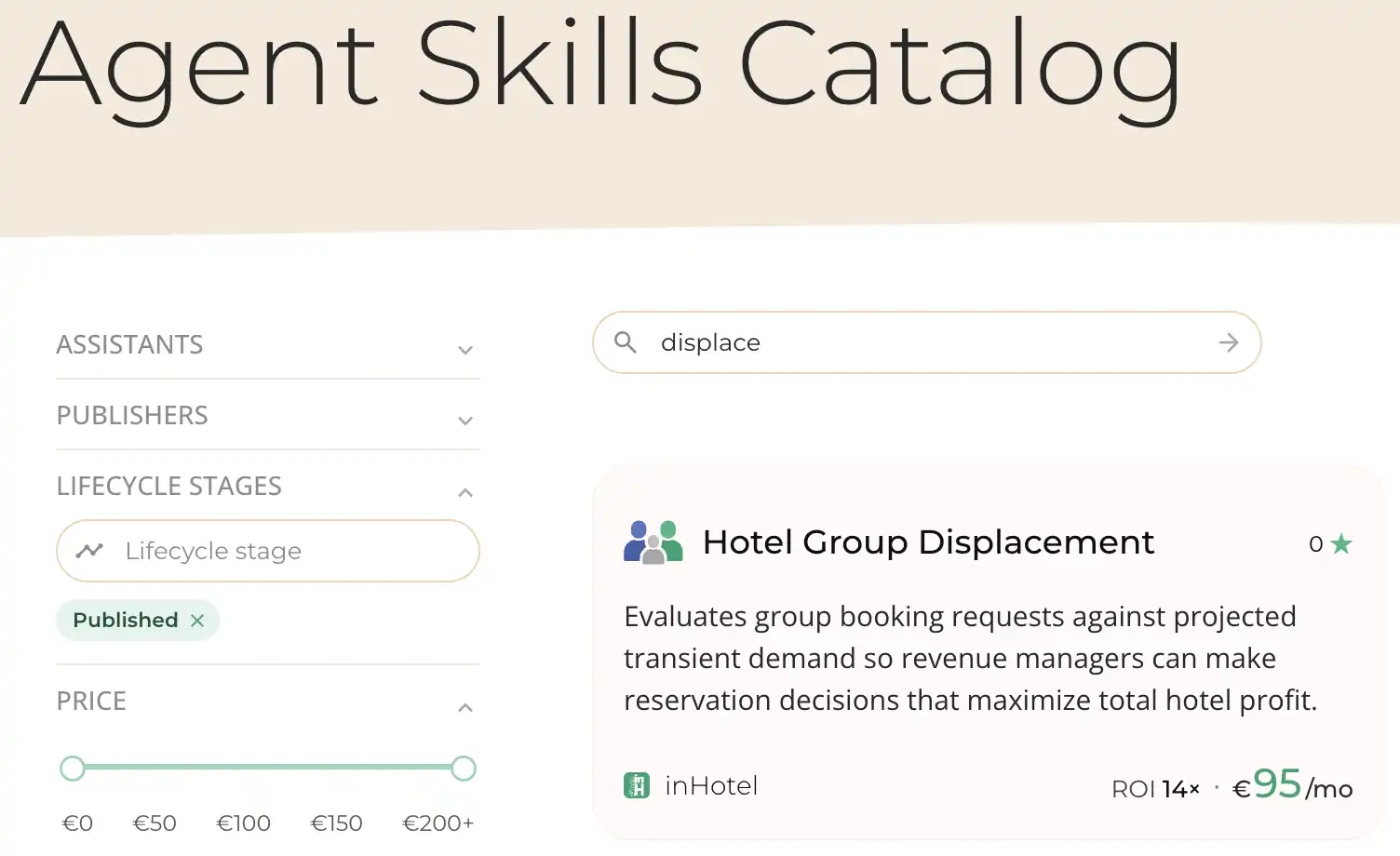
What this means in practice
- Technology costs drop by ~3× because you stop paying for the same infrastructure again and again
- Operational knowledge becomes a monetizable asset that you can distribute at scale while retaining 80% of the revenue
- Each skill is either free or priced to deliver at least 10× ROI for the operator using it
- Workflows stay aligned because they run on the same knowledge layer and shared system integrations
- AI adoption becomes lower-risk and more practical because you can introduce it step by step
Get involved
👉 Have a look at the skills already available in the catalog and what's planned. If something is missing, that’s the point. Submit it.
Hoteliers should decide how AI works in their environment.
Frequently Asked Questions
What are AI Agent Skills in hospitality and how do they work?
AI Agent Skills in hospitality are structured, programmable workflows that encode hotel SOPs, decision logic, and economic thresholds into executable AI processes. Instead of a generic chatbot, an Agent Skill captures how a specific task is performed by an experienced hotel professional and makes it repeatable. For example, evaluating group displacement, scheduling housekeeping staff based on occupancy forecasts, or generating tailored event proposals. The agent retrieves relevant data from connected systems, applies the workflow steps, and outputs a structured recommendation, draft, or action. The result is hotel AI workflow automation that runs alongside teams, improving consistency, reducing manual effort, and accelerating decision cycles across departments.
What is a realistic ROI for AI Agent Skills in hotels?
A realistic benchmark for hospitality Agent Skills is a 10× return compared to the cost of a traditional hotel SaaS tool that still requires manual operation by staff. For example, a Skill priced at €100 per month should generate at least €1,000 per month in measurable value through labor savings, margin protection, or revenue improvement. In Revenue Management, better group displacement decisions can protect thousands in contribution margin. In operations, scheduling automation can reduce overtime and understaffing costs. ROI should be validated through measurable KPIs before scaling. Because the workflow logic and execution structure can be owned assets rather than rented subscriptions, the economic upside can compound over time across properties and use cases.
Can a hotel turn AI from a cost center into a revenue stream?
Yes. AI does not have to remain a pure expense. With inHotel, customers and partners that fund and own a Skill can resell it to other hospitality businesses facing the same challenges. What starts as an internal operational improvement can become a recurring revenue asset, allowing hotels to offset costs or even generate profit from AI adoption.
How do AI Agent Skills overcome hospitality’s fragmented tech environment?
Hospitality fragmentation comes from many legacy systems, varied vendors, and inconsistent integrations across properties. AI Agent Skills overcome this by operating above systems rather than replacing them. They connect to PMS, RMS, CRM, and other tools through APIs, retrieve the required data, and execute workflow logic without forcing a full system overhaul. This lets hotels keep existing infrastructure while improving execution consistency. Because the agent coordinates across tools automatically, fragmentation becomes less of a blocker. Instead of adding more dashboards, Skills centralize how work gets done into a workflow layer that can travel across properties, brands, and tech stacks.
Should a hotel build its own AI Agent Skills or adopt existing ones?
Hotel management professionals have three practical options: adopt existing Skills published by others and deploy them across properties to save time immediately, build new Skills to address unique requirements with the potential to resell them to other hoteliers, or continue relying on manual processes. Adoption is suitable when a standardized workflow already exists and has demonstrated proven ROI. Building makes sense when the hotel or a management consultant has unique expertise they want to capitalize on, especially where the workflow is a strategic differentiator. Both approaches allow gradual implementation, which helps teams test value in real operations while minimizing disruption and change management risk.
How can AI Agent Skills help hotels address chronic staff shortages?
AI Agent Skills help hotels address staff shortages by automating repetitive coordination work that consumes scarce employee time. In a market facing persistent hospitality labor shortages and rising wage costs, teams often spend hours pulling reports, reconciling spreadsheets, responding to routine guest questions, preparing proposals, and scheduling shifts. An Agent Skill can execute these workflows automatically by retrieving data from PMS, CRM, and other tools, applying SOP logic, and producing structured outputs. This increases productivity per team member, reduces burnout, and frees staff to focus on guest-facing tasks and high-judgment decisions. The goal is not replacing teams, but helping fewer people run a tighter operation.
Can AI Agent Skills reduce hotel labor costs without hurting service quality?
Yes, when implemented correctly, AI Agent Skills can reduce labor pressure while protecting service quality. The key is automating structured, repetitive tasks while preserving human oversight for high-touch interactions and exceptions. For example, a Skill can handle displacement analysis, generate tailored RFP responses, build reporting packs, or produce FAQ content optimized for search. These activities often require hours of analysis, formatting, and coordination. By automating them, hotels can reduce overtime, avoid adding administrative headcount, and maintain faster response times. Because Skills are built around SOPs and brand standards, they reinforce consistency and operational discipline rather than diluting service quality.
How do AI Agent Skills differ from hotel AI chatbots?
Hotel AI chatbots primarily answer questions and handle basic conversational requests, often limited to a narrow set of intents and a single channel. AI Agent Skills go further by executing workflows. A Skill pulls data from internal systems, follows SOP steps, applies decision logic, and produces structured outputs or actions such as draft proposals, staffing schedules, variance explanations, or accept-reject recommendations. Chatbots focus on conversation. Agent Skills focus on operational execution across tools and teams. For hotels, the practical difference is impact: Skills can reduce back-office workload, shorten decision cycles, and improve consistency, while chatbots mainly deflect inquiries. Many hotels use both, but Skills are typically where the larger economic value sits.
How can AI actually perform day-to-day hotel work instead of just answering questions?
Most AI tools in hotels are built like polite interns. They answer questions well, but they don’t actually take work off your plate. To change that, you have to train the AI the same way you’d train a new team member. Start with a real task. Think check-in during a busy shift. Not just the steps, but the decisions. When to offer an upgrade, when to skip it because the guest looks rushed, how to handle an early arrival when rooms are tight. That logic gets structured into a skill, a defined workflow that includes the rules, the edge cases, and the expected outcome. The AI follows that playbook and carries it out, whether that means updating the PMS, sending a confirmation, or flagging an issue. Over time, it adjusts to your property’s tone, policies, and systems. It stops being a chatbot and starts acting like someone who actually knows how your hotel runs.
Why are AI agent skills significantly cheaper than traditional hotel SaaS tools?
Most hotel software charges you for the full stack every time, infrastructure, integrations, support, and all the overhead that comes with running a product. The problem is you only care about a small part of that, the piece that actually solves your problem. AI agent skills separate those layers. There is one shared foundation, and on top of that you plug in only the specific capabilities you need, like handling guest emails or evaluating group bookings. You are no longer paying five vendors for five versions of the same backend. That’s where the ~3× cost reduction comes from. It’s not magic, it’s just removing duplication. On top of that, each skill is expected to deliver clear economic value, often 10 to 15 times its cost, which keeps spending tied to results instead of features.
How can hotel tech vendors make existing software AI-enabled without rebuilding their product?
Most vendors think they need to redesign their product or bolt on a chatbot to claim they are “AI-powered.” That’s usually a mistake. A better approach is to leave the core system exactly as it is and add a skill layer on top. The skill acts like a translator between human intent and the system’s API. A user says “evaluate this group booking” or “perform a check-in,” and the skill breaks that into structured actions your software already knows how to execute. The agent handles the interaction, selects the right skill, and routes execution into your system. Your product stays the engine, but it becomes accessible through an AI-driven workflow. No rebuild. No disruption. Just a new way for people, and other agents, to use what you already built.
How can non-technical hospitality teams create AI workflows?
You don’t need engineers to get started, which surprises a lot of people. At the simplest level, an AI workflow is just a clearly written set of instructions, similar to a good SOP. If you can explain how your front desk handles a late check-in or how your revenue manager evaluates a group request, you already have the raw material. That logic gets structured into a prompt, defining the steps, the decisions, and the expected output. From there, it becomes a reusable skill. More advanced versions can connect to systems and run multi-step processes, but the entry point is intentionally simple. Many teams start by turning one painful, repetitive task into a skill, test it in daily operations, and refine it. It’s less about coding and more about thinking clearly about how the work should be done.